 John C. Mannone
Naming Animals
There are animals in the sky. See
those that lurk in the house of stars
where there are stories that I heard
in a dream —beyond the knowing
of fire and light, each star, a word,
each cluster, a story.
Look. That assembly of stars
configured to the likeness of a man,
his legs straddling the mountains
full of snow and moonlight.
Each night he travels the dark path
from the east to the west —Light
of Heaven, a giant, a leader,
a prince crowned with stars, the hilt
of his sword, studded with celestial
diamonds. Some will say he’s
a hunter with a club, and a lion
slain for a shield, which is a closer
truth to the fate of the illumined beast
that relentlessly prowls for whom
it may devour.
So there is truth in calling the prince
a hunter, his foot, Rigel, poised over
the head of a serpent (not of a tamed
rabbit that some will say in the future).
That snake’s head will be utterly crushed
though not before its fangs impale
his feet: the price of redemption
from a brood of vipers. This story
will still be clear in millennia to come,
even in a million years despite the cycles
of this place —lush green or barren tan,
the garden trees or desert sand. It is
written in my dreams.
The stars may change position
but the stories that the stars tell
will remain the same. The whole host
of heaven repeatedly proclaim, even
in the tiniest clusters of stars:
If you squint, you’ll see a unicorn
behind him, frolicking in the field
of stars with his faithful guide dogs.
A unicorn shows purity (or is it
a wild ox?) with immense strength
—a divine power.
Over his shoulders, in a corner
of darkness, there’s a luminous
cedar tree: stars glint as ornaments
as well as a garland of light.
But it will blur in the ages to come,
fading dull to the eye, blind to its story.
Yet, there will be joy in the world
despite the sorrows of being cast
into darkness, the stars, everywhere,
speak of it. These dreams, though strange,
bring me comfort, an uncanny comfort.
The northwest winds are picking up.
We must go. Now,
……………………I must speak
with your mother. Do you know
where she is, Son?
…………..Yes, Father, she’s by the grave in the field
…………..of rocks, offering prayers for my lost brother.
…………..I wish that he were here. He would help us
…………..count the stars, name the animals, share
…………..the stories spoken of in the stars… he would,
………………………………………………………Abel would.
_______________
John C. Mannone has poems in The Windhover, North Dakota Quarterly, Poetry South, Baltimore Review, and others. He won the Dwarf Stars Award (2020); was awarded an HWA Scholarship (2017) and a Jean Ritchie Fellowship (2017) in Appalachian literature; and served as celebrity judge for the National Federation of State Poetry Societies (2018). He has six chapbooks and five full-length collections, including Dark Wind, Dark Water, a novella-length horror fiction collection, forthcoming from Mind’s Eye Publishing (2026). Sacred Flute (Iris Press, 2024) was a top eight finalist for the 2025 Tennessee Book Award, as well as being nominated for an Elgin Book Award. He edits poetry for Abyss & Apex and Silver Blade (on hiatus). He’s a professor of physics living in Oak Ridge, Tennessee.
http://jcmannone.wordpress.com
https://www.facebook.com/jcmannone/
Author’s Comments/Backstory: In this conversational poem between Adam and his son, Seth, I imagine how various mythologies of the constellation of stars might have originated. Long before etchings in stone, let alone papyrus, word-of-mouth was the way that information was conveyed, in particular, by storytelling. When I studied the names of stars, I wondered if there was a link to Adam. Psalm 147, a list poem, speaks of naming the stars (verse 4: He counts the number of the stars; /He calls them all by name). I conflated the idea of Adam naming all the animals of the field (Gen 2:19-20) to naming all the animals in the stars. The naming of animals was not just to assigned a cataloguing name, but something that spoke of the character of that animal; a story would naturally follow for these animals in the stars (and any other storytelling element or character). As far as recorded history goes, the earliest documentation were by the Babylonians and Egyptians 2000-3000 BC, and much later, the Chinese and Greek astronomers had catalogued the stars. During the Middle Ages, Arabic astronomers preserved the Greek words but added many of their own Arabic names/meanings. I found it interesting that many of the stars’ names carried a religious significance. And in this poem, the conjecture is that Adam told the stories by the stars —a device to pass on the traditions, which eventually were reformulated to fit a particular culture’s mythology
The name Orion has ancient Mesopotamian roots (Akkadian) meaning “Light of Heaven” that suggests a much older tradition than the Greek’s, and even the Arabic’s translation into “Giant” and other similar terms, like “Leader.” Other stars in the constellations repeat the story and/or provide more details, like protoevangelium (Genesis 3:15) that Adam was directly privy to, such as, Rigel, that blue supergiant star, means in Arabic: “the foot that crushes”).
I took no poetic license in the images or information of the region but researched the geography. What mountains, if any, would Adam be able to see from Mesopotamia? The mountains easily seen in northern Iraq (especially Mt. Halgurd), which is part of Mesopotamia (which also includes northeastern Syria and southeastern Turkey). There are high mountains in Iraq, especially the Zagros mountains that run SE to NW with 11,800-foot peaks. The constellation, Orion, can be seen crossing the Zagros mountains in the winter when it’s high in the sky. (That image came from a “The Star-Splitter” by Robert Frost, which opens with You know Orion always comes up sideways. /Throwing a leg up over our fence of mountains, /And rising on his hands, he looks in on me.)
In addition, the predominant winds in Mesopotamia are the Northwest winds (the Shamal): strong continuous in summer days (weaken at night); winter shamals bring cold air and dust storms. The region is rainy in late fall to early spring and dry in the late spring to early fall. The climate was significantly wetter and greener in early Holocene 10,000 to 7000 years ago. But even a million years ago, it was a Green Sahara with monsoonal weather vs the Sumerian hot and arid weather we see now. There were cyclic changes in weather (Milankovitch cycles) due to periodicities in Earth’s motions affecting the amount of sunlight falls on Earth: orbital (eccentricity, 100,000- and 405,000-year cycles); obliquity (tilt of axis, nutation, 41,000-year cycle with axis moving +/- 1 degree!); Precession (wobble due to the moon, with a 26,000-year cycle. This is why is lush and green or barren and dry periods affecting Mesopotamia.
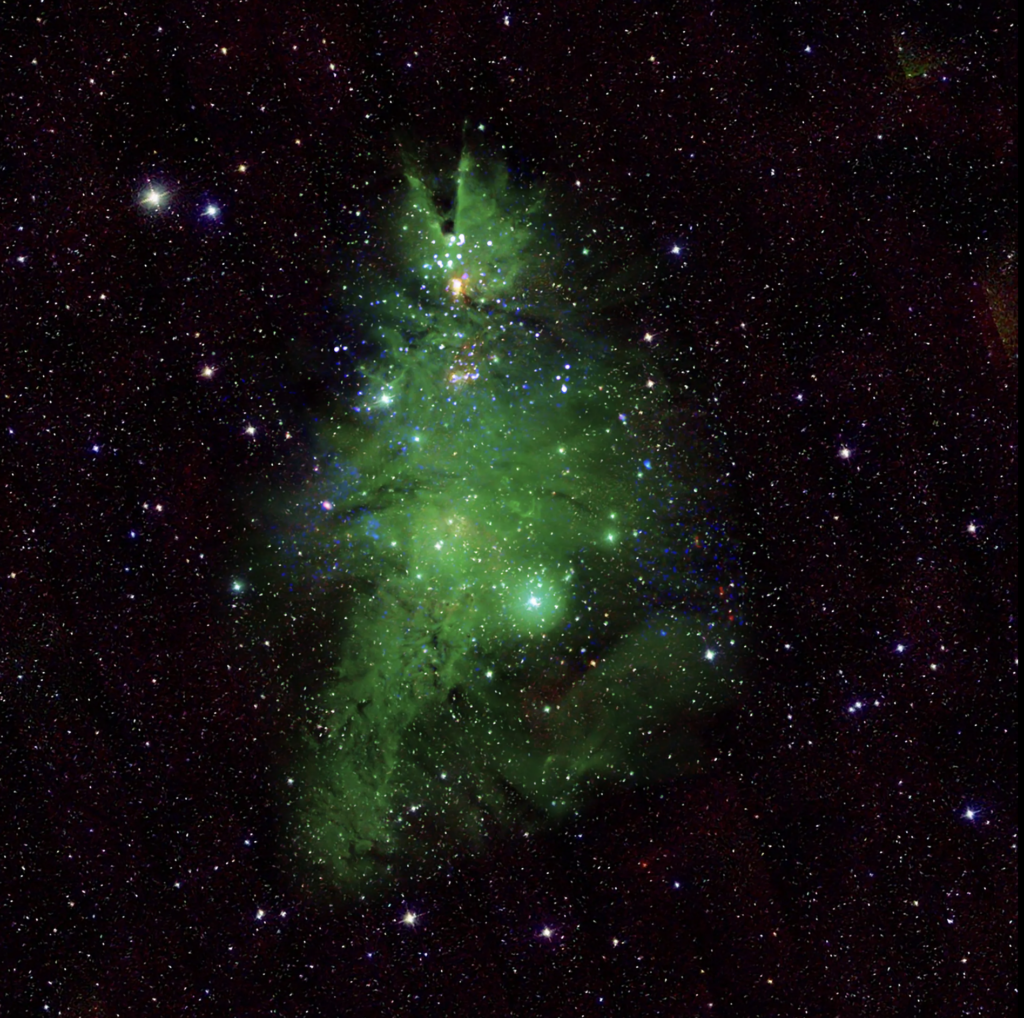
Editor’s Notes: Image source: a composite photograph of NGC 2264, The Christmas Tree Cluster, in the constellation Monoceros (unicorn):
…………….X-ray (blue and white lights; young hot stars)
…………….Optical (pine needle green, nebula emission)
…………….Infrared (white foreground and background stars)
See the NASA article for more details and an animation.
Image credit: The Christmas Tree Cluster —A collaboration among NASA/CXC/SAO, T.A. Rector (NRAO/AUI/NSF and NOIRLab/NSF/AURA) and B.A. Wolpa (NOIRLab/NSF/AURA), and NASA/NSF/IPAC/CalTech/Univ. of Massachusetts; Image Processing: NASA/CXC/SAO/L. Frattare & J. Major