
 He Grows Up
by Janna Layton
I’m an adult, I’m an adult, I’m an adult, Pete Stuart thinks as he scans six-packs and the components of s’mores and places them in the customers’ stained cotton tote. He makes sure to place the marshmallows on top of the alcohol, graham crackers, and chocolate bars so they don’t get squished. I’m an adult doing responsible adult things.
The customers are a backpack-wearing couple in their twenties. Hair unwashed, but not filthy. Clothes dusted with some dirt, but not rancid. Pete thinks that thanks to their nice teeth and acceptable hygiene, people who see them likely assume that although they might do weed, they’re really just kids on an adventure, not someone to cross the street to get away from. Just privileged hippies camping, hiking, maybe traveling by customized van. Trustafarian shit.
Pete wonders how much he looks like them at this point. His hair is fairly clean, and his clothes are laundered. He looks far healthier than he did a year ago. He knows that his whiteness gives him a lot of slack. But his teeth certainly aren’t a model’s, and the tattoos covering his arms are a mishmash of style and quality. If his teeth were whiter and his tattoos were beautifully rendered sleeves, maybe he’d come across as more of a surfer dude and less of a drifter.
He asks the beer-and-s’mores-buying customers where they’re camping, and nods approvingly when they tell him. Then they’re off.
The store is empty for a bit, and he stretches and groans. It sucks, standing in place on your feet all day. No running, no jumping, no flying. No skimming over the ocean or sailing over the tops of trees, leaves brushing his skin. Not even just walking, walking, walking. This is his life now. Being a cashier at a corner store isn’t what he’s best at, but what he’s best at doesn’t make him a living. Stupid capitalism, he thinks. Not that he actually wants to do what he’s best at anymore anyway.
Then a regular ambles in—old, disheveled, dirty—and Pete automatically reaches for the cheapest vodka behind him. The man puts down his crumpled bills, takes his change and the bottle, and leaves without speaking.
That’s where I was headed, Pete reminds himself. No, not that. Worse.
The day continues. He sells beer, he sells soda, he sells lotto tickets. Snacks, minor groceries, painkillers, batteries. Some customers are locals and some are tourists, headed out to the Pacific Coast, or Mount Tamalpais, or Muir Woods, or across the bridge to San Francisco.
Another grungy twenty-something in a faded hoodie comes in and asks for cigarettes. He stares at Pete intently, then asks the dreaded question.
“Do I know you?”
Pete doesn’t recognize him, but that doesn’t mean anything. He can’t recall most of the names or faces from that time of his life. He’d wandered for years, a group of other traveling kids growing and shrinking and changing around him. He hadn’t really cared about any of them, to be honest. This guy’s age seems right. He could have been any of those boys in Seattle, or Las Vegas, or San Diego, or anywhere in between.
He’s only run into one of them so far. “All that stuff…” the twitchy young man had asked in a hushed tone, “that wasn’t real…was it?” Pete had laughed and said, “Drugs, man. Wild shit, right?” It hadn’t exactly been a lie.
“I don’t know if I’ve met you before,” Pete answers honestly to the customer in front of him.
“Did you go to Terra Linda High?” the man presses.
Pete shakes his head as he hands him the cigarettes. “I’m from here originally, but moved away before high school. We were down in Sausalito.”
He hopes the customer won’t ask any follow-up questions, because he doesn’t want to get into it—the child’s paradise of the Sausalito houseboat community, the car accident that killed his mother and injured his father, their subsequent move to his grandparents’ home in England, and then the years and years of drama that ended with him and his father back in Marin County.
Fortunately, the man just pops a cigarette between his lips and leaves the store with a friendly, “Have a good one.”

After work, Pete takes the bus. As it heads south, he catches glimpses of the beacon of his childhood: Mt. Tamalpais, named by the Coast Miwok. The name, often shortened to Mt. Tam, remained even as the people were displaced by greed and killed by disease. The mountain’s peak rises from a range of smaller mountains, then slopes steeply down to a valley. He remembers visiting the top with his parents when he was little: him perched on his dad’s strong shoulders, his mom laughing at how the wind made her hair uncontrollable, and the whole world laid out before them.
As the bus continues along 101, it passes shopping centers, apartment buildings, an RV park. Besides the flashes of natural beauty when the bay or mountains come into view, this stretch of highway could be anywhere in America. But it’s not. Away from the highway are prim neighborhoods of simple, unremarkable single-family homes valued in the millions by virtue of their location. Years ago, his parents had been able to afford the rent for a whole house—or at least a houseboat—but that wouldn’t be possible now. Sometimes, when Pete walks through nice neighborhoods, he sees signs decrying the development of multi-family housing. He always flips them off, and sometimes scribbles on them.
The Mill Valley apartment he and his father share is behind a shopping center just off 101, not far from the bus stop. When he gets inside, he flops down on the couch, which is also his bed. Being at work all day makes him exhausted and restless at the same time. His therapist—the very specialized therapist his dad had to move mountains to find—has suggested he go running after work. He gets why, but he can’t picture himself as a runner: as someone who puts on special running shoes and running clothes and jogs down the pavement instead of racing barefoot across lush fields. Or instead of plodding down endless asphalt in shoes nearly worn through, wearing a dirty backpack and soaked with sweat. Those were his two realities for so long.
He decides to take a shower, because that’s at least something to do besides napping. He thought showers wouldn’t feel as luxurious at home as they did on the road, but somehow, they do. This shower feels just as good as the one he had in Sedona, when after a full day of traveling in the Arizona heat, he reached a solar-powered commune with facilities. He’d showered in storm-gathered water, cleaning himself with the group’s handcrafted soap, and then had sex with a woman who made crystal necklaces.
As he towels off, he thinks, I took a shower. A responsible, adult thing to do. A full day of work, plus a shower.
He supposes something he could do now would be to get back on the bus and go down to the old neighborhood in Sausalito, but he’s been before and it hurts too much. Going there feels like chasing ghosts, a stark reminder of a time when his happy, artistic mother was alive. When his father spent the days repairing boats for a living, then in the evenings, would teach him how to astral project, and they’d “fly” over the moonlit bay. He doesn’t want to look at their old houseboat and think that if not for the accident, it might still be their home.
So instead of going out, Pete puts on sweats and a t-shirt and hangs out on the couch, playing games on his phone until the front door of the apartment opens to reveal his father. Jim Stuart’s once-black hair is now salt-and-pepper, and his pale blue eyes look tired. He’s wearing a polo shirt emblazoned with the logo of the boat rental company he manages, and there’s a white cooler tucked under his arm with the prosthetic hand.
“Greetings, kiddo,” he says in his English accent.
Pete reminds himself to be proactively helpful and take the cooler from his dad. It’s something he’s been working on with his therapist: noticing others’ needs, not just being in his own world.
“What’s this?” Pete asks, placing it on the counter.
“Halibut,” his father says. “From Steve and Jenny. They came by on the Bay Beauty today.”
Steve and Jenny were their neighbors back at the houseboat community. They’re an older couple, and some of the few holdouts from that time. Most of the houseboats that previously held squatters, artists, and boatmen are now pristine vacation rentals, but Steve and Jenny’s is still an eclectic hodgepodge of nautical accoutrements, Steve’s “bottle art,” and Jenny’s garden gnomes. It was their guestroom his father stayed in initially when he came back to the US to look for him. Pete lost his mind when he found out, when his father unexpectedly appeared in San Francisco’s Golden Gate Park, where Pete had been sleeping.
“You’re staying with Steve and Jenny?” Pete had yelled over the noise of a nearby drum circle. “Why didn’t we just live with them after the accident? You made me move to fucking England!”
“Peter, we couldn’t have imposed on them like that,” his father had argued. “It’s a very small houseboat, with only one guestroom.”
“We could have gotten bunk beds!” a furious Pete had retorted.
After their halibut dinner, Jim sits on the couch and turns on the TV, and Pete goes to the bedroom for his remote therapy session. He and the therapist meet via video conference since Pete refuses to astral project anymore, even though the video lags sometimes because Dr. Prasad is far away in India. The time zone difference isn’t ideal, and she’s definitely not in his insurance network, but Dr. Prasad is the therapist his dad managed to find who is not only an astral projector herself, but has a clinical focus on trauma and addiction.
From the laptop screen, Dr. Prasad smiles warmly and asks about his week. Pete shrugs.
“I dunno. Work’s fine, I guess.”
She prods some more, and he desperately searches for something relevant to say. His dad is paying for this, so he wants it to be worthwhile. Finally, he settles on the earlier incident where he thought someone might have recognized him.
“And what worries you about that?” Dr. Prasad asks after a long pause, which is mostly the connection lagging. “This happened once before, didn’t it? Somebody recognized you, and you explained it as the drugs you were all on, correct?”
“Yeah,” Pete says, “but what if others don’t buy that? What if they’re really mad about it? Like, what if I made them think they were crazy, because let’s face it, as far as they know, none of that shit should have been possible? Or what if they’re thrilled to have found me and want me to do it again? Because that would happen on the road sometimes. I’d run into someone I’d traveled with before, and they’d beg to go back. Beg like it was meth.”
“Well, what would you say now if someone asked you?”
He shrugs. “I guess I’d just say that’s not my life anymore?”
His therapist smiles. “That’s a perfectly good answer. You still look uncertain, though.”
Pete looks down. His stomach twists, and he wishes he hadn’t brought this up at all. “I just…what if some people did really get fucked up by what I did?”
“Peter,” Dr. Prasad says, “from what your father has told me, the world you were able to create with astral projection, and the powers you held within it, were…exceptional. I’m not questioning that. But astral projection has been around and part of various cultures for a very long time. Some societies would consider what you did just an extremely vivid guided meditation.”
Pete scoffs at that, but Dr. Prasad continues. “From what you’ve said, it actually sounds very innocent in a lot of ways. Becoming a child again, playing games…I believe you said there was not even sex in this world.”
“No. That would be gross, because we were always kids there,” he says. Part of him wonders if he should tell Dr. Prasad about how maybe it’s related that his first sexual experience was with an eighteen-year-old girl when he was thirteen. But that seems like the sort of biographical note a therapist would make into a Big Deal and Pete doesn’t want to get into it.
“What I’m saying is, I think you need to give yourself a bit of grace here,” Dr. Prasad says. “You could have done a lot worse.”
“I mean, there was also the robbing,” Pete reminds her.
When he needed money on the road, he’d do a much easier form of astral projection. He’d find someone drunk or stoned, hide, then astral project himself at them in his flying child form, telling them to throw their wallet on the ground. They usually would, while screaming.
“Well, that is obviously a bad thing to do, and we’ve discussed that,” says Dr. Prasad.
“Plus, I ruined my dad’s life.”
“Peter, you’re being very self-recriminating this morning—or night, where you are.”
“But it’s true, isn’t it?” Pete asks. “He had to move back from England, where his parents live and there’s universal health care, to fucking America. He had to spend years searching for me, both on the astral plane across and the country. He had to deal with all my shit for years, begging me to come home, fighting with me in actual goddamn astral battles. There was even that rehab he paid for that I snuck out of—God knows how much that cost.”
He rubs his face with both hands. It really is overwhelming when he thinks about it all: everything his dad had done trying to get him off the streets. And the years of begging and yelling and rehab and metaphysical warfare weren’t even what worked. One day, Pete woke up in an encampment near Albuquerque, splattered with vomit he wasn’t sure was his, and thought, What the fuck am I doing with my life?
On the screen, Dr. Prasad looks at him calmly, and Pete knows she’s making a meaningful pause, that it’s not just the internet.
Finally, she says, “You said your father ‘had’ to do those things. But did he?”
Pete stays silent.
“He didn’t,” she answers for him. “He left England and spent all those years trying to get you home because he loves you and you make his life better. Does your father seem happy now?”
“Yeah,” Pete admits reluctantly, “but that’s because he’s relieved I’m not passed out under a bridge astral-projecting myself and bunch of other ‘Lost Boys’ into a dream world.”
“I’m relieved as well,” says Dr. Prasad with a wry smile. “Both you and your father have been through a lot. But you have each other now. And Peter, look how far you’ve come. You’re sober. You’re clean. You’re inside. You’re doing great.”
When Pete goes back to the living room, his father is watching the news and frowning.
“There was a murder up in Petaluma,” he says. “At a convenience store.”
On the TV screen, a news anchor is talking next to a superimposed photo of the suspects. It’s a still image from grainy security camera footage, which has vaguely captured two people in all black. With their hoodies and masks, there’s not much to distinguish them by.
“It happens,” says Pete grimly. “Was the cashier trying to play hero?” A large part of his training at the store was that if someone comes in with a gun, just give them what they want and call the cops when they leave.
But his father shakes his head. “No. The cashier gave them the money.”
That’s unnerving, but Pete refuses to show it. “What pieces of shit.”
“You work late tomorrow, don’t you?” his father asks.
“I’ll be fine, Dad,” Pete says quickly.
“Is it just you at the store? Maybe your boss should have you all work in pairs until they catch these guys.”
Pete rolls his eyes. There’s no way the stingy owner is going to pay double for their safety. “Dad, I was literally on the streets for years, and we both know they weren’t the streets of Belvedere. I can protect myself. Plus, you’ve seen me fight. No—more than that—you’ve fought me. With swords and everything. And, reminder: you never won. I think I’ll be ok.”
His father doesn’t look convinced. “That was on the astral plane. These are two murderers an hour away with a gun.”
“I’ll be fine,” Pete repeats. “I’ll be extra careful, ok?”
Jim sighs and turns off the TV. “I worry. It’s what parents do. Why don’t you get a rideshare home? Or call me to pick you up if there are any suspicious people about.”
Pete has no intention of using money they can’t spare on a rideshare, or calling his father, who works in the morning, to come pick him up when he closes the store after midnight. “Sure,” he lies.
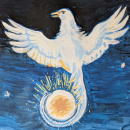
His father gets up, ruffles Pete’s hair, and tells him goodnight. Pete unfolds the sofa bed and gets under the covers. On the wall above him is a painting his mother made. It shows a mystical white bird with a long tail curving around a ball of light. One of Pete’s tattoos is a reproduction he sketched of this image with his mother’s initials underneath: CS, for Cindy Stuart. In the houseboat, the painting hung over the dining room table. When Pete looks at it, even without astral projecting he thinks he can feel himself back there. He can feel the gentle sway of the ocean, he can hear the other kids playing outside on the dock. He can imagine his mom painting in the houseboat’s sunniest corner.
In England, living in a strange house with grandparents he had only met twice before and who had never seemed to like his mother, Pete used to visit a vision of the houseboat on the astral plane frequently. At first, he would imagine his mother there, alive, and his father, uninjured. But then it became too painful—waking up to no mother, to a father who was maimed and despairing with haunted eyes. Instead, he focused on recreating on the astral plane the joys of running around the dock with the community’s other children, playing along the water. They had pretended the dock was a magical island where they fought pirates. Pete made that island real in his mind, and over the years it grew in size and detail.
Meanwhile, in the real world, he hated his new school, where he was teased for his accent and for being behind in some subjects. He started gravitating toward the rougher kids, the ones who didn’t care about what adults wanted them to do. At home, his grandparents were strict and disapproving. His great-grandmother’s astral abilities had apparently been regarded with suspicion and discouraged, and his grandparents hadn’t been thrilled when the ability manifested in their son. When their grandson began spending hours projecting, they punished him, which only made him cling to it tighter.
Looking up at the painting now, Pete has a fleeting thought of using astral projection to try and visit the houseboat the way it was then, but ever since leaving Albuquerque—even though he would love to feel the sensation of flying again—the thought of projecting makes him sick. Part of his reluctance is that astral projection feels like a food he overindulged in and now can’t stomach. The other part is that he’s worried that if he partakes, it will be the opposite—just as good as it was early on, or even better. What if he can’t resist? What if he’s sucked right back in to that enchanted island?
I’m here, in the real world, he thinks, grounding himself the way Dr. Prasad taught him. I’m here in this small apartment, on this bumpy sofa bed. Dad is nearby. I can hear the traffic from 101, and I can smell the halibut we cooked with lemon. Outside are the bay and Mt. Tam. Above me on the wall is the painting Mom made.
Behind the store’s counter, Pete practices flipping a pen and catching it, pausing occasionally to glance out the windows. It’s late night: the slow-but-dangerous time where armed robbery is more likely. The few people who do come in are often drunk or looking to be, or they’re having an emergency. A stressed young man asks for something in a confusing mix of English and Spanish. When Pete guesses correctly and presents him with a container of baby formula, the man almost cries, and Pete feels like he’s actually helpful to society. He feels less so when an older man comes in and perplexingly demands to know if they sell billiard tables, then swears up a storm when told they don’t.
At five minutes to closing, a woman comes in looking like she’s rolled out of bed. She’s wearing a stained, oversized sweatshirt and pajama pants decorated with the logo of a sports team. Her hair is pulled back in a messy ponytail.
“Thank God you’re still open,” she says, putting a bottle of medicine on the counter. “My daughter’s sick.”
“That sucks,” Pete says, scanning the bottle. “I hope she feels better soon.”
As he puts the bottle in a bag, the door dings open.
Two men come in, and just as it clicks in Pete’s head that they’re dressed like the suspects on the news—all black clothes, faces obscured by hoodies and masks—a gun is out. The woman makes an aborted scream.
“Get against the wall and don’t move,” says one of the men to her.
Pete can hear the woman’s panicked breathing as she complies as best she can. The wall is blocked by a shelf of snack cakes, so she stands there, back against the snack cakes, while the second man stands between her and the exit. Pete remains in place with his hands up.
The man with the gun looks him in the eyes. Pete can see part of a sunburnt forehead and intense, dilated pupils. He’s seen eyes like this before, and he knows their danger.
“Keep your hands up,” the man says. “You got the keys on you?”
Pete nods. They’re clipped to his belt loop.
“You’re going to come out here slowly and lock the doors.”
His brain sputters. This isn’t how a robbery goes, and it isn’t even how the murder the other night went. These dangerous men have something different planned: an escalation. He feels two distinct beads of sweat roll down his back. Once he locks those doors, with him and the woman and the murderers inside, what will happen?
He glances at the terrified woman, who only wanted to help her daughter and is now huddled against a snack cake display. Righteous indignation flares within him.
Don’t these fuckers know who I am?
What happens next neither the woman nor the security cameras can fully perceive. What Pete does would be a difficult task for many astral projectors, but Pete isn’t one of the many. While remaining upright, he focuses.
The man with the gun shoves it near his face. “I said come over here and lock the doors!”
“But I am over here,” says a voice behind the men.
They startle, whirling around, and there is Pete, smirking. The man with the gun screams and fires. The bullet goes through this second Pete and punctures a gallon of engine coolant. Fluorescent green liquid glugs to the floor. Second Pete grins.
“What the fuck are you?” yells one of the men.
“I’m something cowards like you could never understand,” says Second Pete. He levitates off the floor, looming over the men with a menacing smile. “Drop the gun, and if you’re smart, run.”
The gun clatters on the epoxy flooring as the men scramble away. When the door swings closed behind them, actual Pete—still behind the counter with arms raised—finally allows himself to fold over and let out a shaky breath against his palms. Then he grabs the phone, and although he knows from the training that it’s supposed to be the cops he calls immediately, he’s suddenly shaking like a leaf and dials another number first.
“Dad!” he cries the moment his father picks up.
Sometime later, after the police’s arrival, the shop owner’s arrival, witness statements, identifying the assailants, and a reminder from the cops that your first call in a life-threatening situation should always be to emergency services and not your dad, Pete and his father climb into Jim’s used sedan and are soon on their way down 101. Jim looks just as shaken as Pete feels, and they drive in silence for a while.
Finally, Pete says, “Sorry I made us come back to the gun violence country.”
His father nearly guffaws, but shakes his head at his son’s candor. “That’s not funny.”
“No, for real,” Pete continues, a slight smirk on his lips. “I made us come back to the guns-and-no-universal-healthcare country. And like, the most expensive spot on it. That’s on me. My bad.”
His dad gives him a wry look. “I forgive you.” But then he turns back to the road and his face turns solemn. “How serious are you being, though? Did you…did you want to go back to the UK?”
His tone is incredulous, and for good reason. Pete had made his hatred of the move and everything about it very well known, and he had left the country entirely the first chance he got.
“I mean, no,” Pete says, frowning at the idea of seeing his grandparents again. If they disapproved of him before, he can hardly imagine what they think of him now that he’s a heavily tattooed ex-drifter who put their son through years of hell. “But I’d understand if you did. It would probably be easier, living there.”
“I moved here for a reason,” his dad replies. He sighs, then adds, “I’ve always regretted uprooting you like that. I’ll always wonder if…” he trails off, and guilt strikes Pete’s heart. He knows what his father is thinking: that if they hadn’t moved, Pete never would have spiraled out of control like he did.
Pete himself told his dad that many times, screaming “This is your fault!” on both the streets on Portland and the shores of Neverland. His father had been the villain in his mind: the cruel pirate who took him from everything he’d ever known when he needed it most.
But Pete sees it differently now.
“Dad, your wife had just died,” he says. “You had just lost your hand and your livelihood. You had a child and no family of your own in the US. Mom’s shitty parents lived in Kentucky. What the fuck were you supposed to do? I didn’t get that as a kid, but I do now. There was nothing else you could have done.”
Jim doesn’t say anything, but his eyes glisten and he holds the wheel steady with his prosthesis for a moment to grip Pete’s shoulder with his other hand. Somewhere on their right in the darkness is Mt. Tam.
“By the way,” Pete says, “I couldn’t tell you earlier because of the people around, and you probably guessed, but I astral projected tonight.”
His father had been present when Pete and the woman talked to the cops, and had heard their story of how the two criminals apparently hallucinated, shot a container of engine coolant, and ran out of the store.
“I figured,” Jim says. “You’re a hero, kiddo.”
Pete snorts. “According to the video footage, I just froze in place, then called my dad.”
“How did it feel, projecting again?”
Pete considers that. “Fine. Natural. But not like, ‘man, I have to do that again ASAP.’” He blanches. “Oh, shit.”
“What?”
“I just realized…when I projected, I was my adult self, which is good, but I was wearing that outfit. From Neverland.”
“The one made of leaves?”
Pete nods, and they both laugh.
“So, you terrorized them while looking like you were starring in Shakespeare’s A Midsummer Night’s Dream,” says Jim. “A tribute to your British roots, perhaps.”
“When I was younger, I thought that outfit made me look cool and wild, like a dangerous forest kid,” said Pete, his face red at the memory. “I don’t plan on astral projecting again anytime soon, but if I do, it won’t be in a weird leaf tunic thing.”
“Glad to hear it,” his dad teases. “And I’m glad you’re safe.”
Pete smiles. They’re in Mill Valley now, and in a few minutes, they’ll reach their too-small, too-expensive apartment. It’s not Neverland, but it’s home.
_______________
Janna Layton lives in Walnut Creek, California. Her writing has been published in various places, including The New Yorker’s Daily Shouts, Apex, Luna Station Quarterly, Cosmorama, and Seaside Gothic. She is on Threads as @sweetsillyeponine and BlueSky as @jannalayton.bsky.social.