
 What’s Written in the Cards
by Deborah L. Davitt
The cards smelled musty and wrong, like the interior of a pensioner’s home. That was the first thing Winifred noticed as she removed them from the antique box she’d found in her father’s safe. They hadn’t even picked up the fragrant aroma of the sandalwood that had surely been chosen to conceal the odor of . . . not leather, not sweat. Just . . . old flesh.
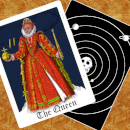
Oddly supple in her fingers, the cards lacked the gloss of modern playing cards; the backs were all black and white woodcuts that traced perfectly circular astronomical paths of planets around a sun that had a face that looked more like a skull than a human visage. There were also rather more cards in the deck than she’d have expected—more than the conventional fifty-two, and more even than she’d have expected from a Tarot spread. “What is this?” she muttered, riffling them lightly. “Why would Father lock this up?”
She wasn’t supposed to be in the safe. Her father kept papers in there from his work with the Foreign Office. But she was down from London on break from her studies at Bedford College, and she’d heard twenty verses and a chorus from her mother on how useless a degree in archaeology was—it wasn’t as if it would be safe for a young lady to go on digs in Egypt!—and shouldn’t she just find a nice young man and settle down?
Her father hadn’t said anything at all. Hadn’t responded to her perfect grades or her tentative request for funding to join her professors in fieldwork that summer. Hadn’t said a word.
But his silence often said more than her mother’s loquacious outpourings. Fine, Winifred had thought mutinously. I’ll get my passport out of their safe and figure out the funding myself.
It hadn’t been hard to figure out the combination. Her birthday, her brother’s—the dial had practically stopped on the correct numbers of its own accord.
But the sandalwood box had caught her eye, and now its contents held her gaze with mingled fascination and revulsion. Winifred fanned the cards out on her father’s desk.
“What are you doing?” Michael, her brother, demanded from the doorway, and she jumped.
“Getting my papers. Till I found these.” She stuck her tongue out at him, covering her shock.
“Papers?” Her twin sounded dubious. “You’re really set on going to Egypt, then?”
“I’ll find the money somehow.” She regarded him. “You wouldn’t want to go, in my place?”
Michael snorted softly. “God, no. The hellish irony is, Father’s sent me to Oxford in the expectation that I’ll follow him at the Foreign Office, but I’ve had enough of travel. Packing up every two years and traipsing between India and China, or the United States and Russia. I’d rather just settle here in London as a barrister and never leave again.”
Her lips pulled down. “He sees value in you. Studying dusty bits and bobs of ancient civilizations, well. That’s a nice hobby, but not a suitable for a girl.” She sighed. “If I want to do it, I’ll have to do it on my own.” Winifred lifted the cards, adding lightly, “Fancy a hand of gin before I put these away?”
His eyes landed on the cards. And stayed there, fixed. As compelled as she was, herself, perhaps. “They won’t be back for hours, right?”
“Not till past nine, they said.”
“Why not, then?”
She shuffled and cut the cards, which bulked large in her hands, as Michael looked inside the box and removed a yellowing scrap of paper. “Says these once belonged to John Dee. Were taken by his son, Arthur, to Russia, when he served as court physician to Tsar Michael the First . . . presented as a gift to the Tsar’s family . . . stolen by Rasputin, recovered by the Romanovs, smuggled out of Russia during the Revolution and returned to Dee’s descendants. That’s us. Father said so, once.”
Winifred blinked. She was holding artifacts of a distant time, with an intimate relationship to her own family. “Dee was an astrologer and court magician to Elizabeth I, wasn’t he?” Their father had been tight-lipped about their family background for as long as she could remember.
Michael nodded and sat down across their father’s desk from her. “Come on, deal. You’ve been shuffling for half of eternity.”
Winifred chuckled and skated cards back and forth between them. Ten to a hand. As she flipped the first over to check it for suit and number, she expected woodcuts on the face side as well—but instead, lurid, hand-painted color appeared. A red-haired woman, in stiff Elizabethan ruff and lace, holding up a scepter as she stood atop what were clearly the white cliffs of Dover, staring out to sea, where a huge storm brewed, lightning in its belly.
And as her fingers touched the image, Winifred was suddenly there, standing beside the woman, whose face, while young, was pockmarked and sallow. Wind whipping at her face and hair, the smell of rain on each gust, the reek of brine from the waves tearing at the cliffs far below. “Art thou certain that this working will suffice?” the woman called, strain evident in her face. “The Armada is vast.”
“Then so must your storm be, your Majesty,” a man’s voice called over the wind. “The angels and spirits advise that there is no power without sacrifice. You must give up something that’s worthy of a storm such as this one, my lady.”
The narrow face turned more pinched. “Children!” she shouted into the wind. “Take from me my ability to conceive an heir. So long as my people stay safe, it matters not who follows me!”
The storm darkened. Thunder shook the air.
And then Winifred reeled back into her father’s chair, and the card’s colors faded into muted shadows, yellowed with age and varnish. She darted glance at her brother, who didn’t seem affected as he shuffled cards around in his hand, arranging them. He looked up briefly, and muttered, “Going to be a devil scoring these hands. Cups, swords, coins, wands, stars, moons, ships . . . how many suits does this damned deck have?”
“It probably was designed for a different sort of game,” Winifred replied, her mouth dry. “Maybe . . . we should put them back in the box.” But the rational part of her brain scoffed at her, the way she’d laughed over the notion of a curse on Tutankhamen’s tomb. Superstitious thinking, nothing more.
Michael gave her a dubious look, then lifted the first card off the deck, frowned, and discarded it. Vivid colors stained his fingers as he moved them away, and Winifred swallowed again, disturbed. On the now-visible face, a one-armed man in a Napoleonic-era uniform stood on a ship, telescope clapped to his good eye. She’d have had to have been an idiot not to have recognized Admiral Nelson. “Nelson? In a Renaissance deck?”
“Perhaps other cards were added over time, to commemorate notable events?” Michael offered.
She picked it up cautiously, not to add it to her hand, but to examine it, to see if it looked any less aged, the varnish less yellowed—
—and a deck pitched beneath her feet. Her stomach dropped out of her and she fell to the planks with a thud. Cannons roared, the kind of thunder she dimly remembered from the Blitz, as her parents had retreated to the countryside with their young children. Winifred slammed her hands over her ears, trying to block out the sound. Tried to stagger back to her feet, coughing and choking on the reek of black powder in the air. “Close the gap and fire again!” the admiral shouted to one of his men, closing up his telescope. As he turned towards her, he reached into a pocket and produced a large playing card. “We all must do our duty,” he murmured. “And what’s one little life, when it’s all I have left to give?”
Winifred closed her eyes, and when she opened them again, she sat once more in a comfortable chair in a warm study. “We shouldn’t do this,” she muttered, folding up her hand and preparing to put it in the box.
“We only just started playing.”
“You didn’t . . . you didn’t see anything?”
Michael frowned. “Did you?”
Their eyes met. A lifetime of little tells flickered across their expressions. The twins could read each other as no one else in the family could. Warily, Winifred replied, “Maybe I did.”
“And maybe I want to see what happens next. Come on. What can it hurt?”
Winifred bit her lip and settled the Admiral into place beside the Queen, and extracted a card that—thankfully—didn’t light up her mind with images or sounds. A three of wands, it seemed. She set it into place on the discard sack, and regarded her brother expectantly.
Winston Churchill was on the next card—a powerful minister in place of a King in the stars suit. She felt beyond surprise at seeing such a modern person, painted still in such perfect antique detail.
And then the battle of Jutland assailed her next, that both sides had called a ‘victory,’ and that had claimed so many lives. Then, a sense of a card being smuggled across Italy. Tucked into the pocket of a pilot launching a torpedo plane off the deck of the HMS Illustrious, and swarming the Italian fleet in the warm waters of the Mediterranean.
Sweat rolled down from her hairline as she tried to decide her strategy. She could collect these. While they slammed at her psyche, they were . . . safe. They’d been used, they’d spent whatever power, whatever vitality they’d once had, surely? But every time her fingers reached for the looming stack of remaining cards, she felt a sense of unaccountable danger. As if the potential in the cards that remained held some sort of static charge that could flood through her like electrical current. “Do you want to win?” she asked her brother. “Or do you just want to see what each card does?”
“Don’t say you want to quit now. If we find the right ones, we can have what we want, Winnie. We can both have the futures we want.”
“How do you know that?” Suspicion suddenly gripped her, and she caught the fleeting look of shame flickering across his face. “Michael!”
“Father showed me the deck last summer. Wouldn’t let me touch them, only handled them with gloves, like a docent at a museum. Tried to tell me it was part of our legacy, and that’s why there always had to be one of us in the Foreign Service. Someone who could use the deck on behalf of . . . Queen and country.” Michael swallowed. “I didn’t believe him. Not then. But I do now.”
Her fingers perspired against the cards, which felt as warm as a hand clasping hers. She half-expected them to squeeze her fingers in return. “But it takes sacrifice, doesn’t it? You have to give something up. And if we’re playing a game with them, that means that one of us has to lose, doesn’t it?” She tried to offer him her fan of cards, but her hands remained locked in place around the cards, frozen in place.
Her words caught his attention. “Fine. We’ll quit.” A look of strain crossed his face. “I can’t seem to put the cards down,” Michael admitted after a moment. “Just . . . play it out, Winnie. I’m sure it’ll be all right. We’re not asking much, after all.”
Dread rose in her. No. No it won’t be all right. Someone has to lose. Sudden, angry defiance rose in her. And I don’t want it to be me. I’ve been the loser in this family all my life. I don’t want my future sacrificed again. Winifred swallowed. Think. You need books of the same suit, runs of numbers, or, best of all, both. Ideally equaling ten cards with only one discard. She kept the Queen and the Admiral, looking to match them with two more face cards of this type. Kept Jutland but discarded Taranto, no longer asking how modern aircraft carriers could be depicted on a Renaissance deck, in the same varnish-ambered colors as all the rest of the cards.
Her fingers skittered as she lifted the next, hoping for a King—maybe Henry V at Agincourt!—and found herself standing in a Siberian wilderness. Why, this must have only happened a year ago! The newspaper in one of the students’ hands—she couldn’t read Cyrillic, but the date on it was 1959, as they started their long skiing expedition in the wilderness of the Urals. But she knew, somehow, that a card rested in the pocket of the oldest man—the one named Semyon, but who insisted that his students call him Alexander, and that radiation curled along his bones. And in the middle of one snowy night, he pulled the card from his pocket, and a howling blast of maddening wind burst through the campsite, and the young people went running into the night, naked and terrified.
And when their bodies were found, there was another among them, face damaged beyond recognition, that the searchers took to be Semyon’s . . . but was the body of a convict. And Alexander—now once more traveling under a new name—wended his way secretly out of Ukraine, with priceless secrets in his mind. Made his way down into Iran, controlled by the Shah, and to the British embassy there. Where he was greeted by a man who wore her father’s face, who accepted the card back from him. “Welcome to British soil. We’ll take excellent care of you, Mr. Zolotaryov.”
Her stomach churned, and she sorted the Fool mechanically beside the Queen of Storms and the Admiral. “Father knows. Father’s used the cards.”
“He said so, yes. On behalf of the national interest.”
“I saw him. Taking one back from a spy who’d been given it to defect safely.” Winifred swallowed down nausea. “Was this one man and what he knew worth the lives of nine college students and a convict?”
“Someone thought so.”
“Father thought so,” she countered. “Ten people for one man. Michael, we can’t afford the price the cards are going to set.” She hesitated. “Maybe . . . maybe we can’t lay the cards down. But we don’t have to pick any others up,” Winifred offered, the words coming thickly through her numbing lips.
“And do what? Wait for Father to come home and take the cards out of our hands?”
“Do you think it would be that simple?”
“Do you, Winnie?” Half-accusing, half-pleading. “Do you want to face his disappointment when he sees what we’ve done?”
No. She didn’t even have to say the word out loud. Michael could read her face as easily as easily as she could read his, and she knew her shoulders had just slumped. No matter that they were twenty-two, no matter that they should be capable of making their own decisions and living their own lives, their father’s disappointment remained crushing.
She was suddenly reminded of a scrape from years ago, where they’d both been caught scrumping apples from a neighbor’s yard. The infraction had been minor, and the neighbor hadn’t even been angry with them. “The food will just go to waste if no one picks it,” the old woman had said amiably when their father had walked them over to apologize and to make them do chores for her to make up for their transgression. “I want no thieves in my house,” he’d told the woman tersely. “They’ll work in payment for what they’ve taken.”
That same down-elevator sensation, just on the verge of nausea, came over her again, then as now.
“Let’s just finish this hand,” Michael whispered. “After all, we have to know who wins.”
“Can’t we both win?” Winifred asked, feeling helpless. “Can’t we both just have what we want? A life away from here for me? A life of peace for you?”
She felt as if the cards were listening. As if they were hungry for her words, which fell into silence as she spoke them.
“I don’t think we can,” Michael answered, the words sounding as if they were dragged from him. “I think it’s going to take a price.”
Always a price. Always a sacrifice. Oh god, how do I pick what to give up? “Children,” Winifred blurted. “Just like Elizabeth I. I give them up, you hear me? That’s my sacrifice.”
Nothing happened. “Has to be something . . . you wanted. Or valued,” Michael mumbled.
“What . . . happens . . . if we don’t choose . . . ?”
Cards slapped down. Fingers sorted. With each card discarded, a sense of doom rose around her, pressing in like tight walls.
She’d managed to build a book of five face cards—Queen of Storms, King, Admiral, Fool, and now the Traitor—surely, that was Cromwell and his Roundheads. And a run from ace to four in stars, though the stars glimmered on the edges of the cards, looking more like the model of an atom—in fact, if she looked closely enough, she thought she could see something moving rapidly in the arcs that encircled the nucleus that was the star’s heart. And then she lifted another card from the deck, and it was the five that she needed.
A little surge of victory under her heart. The taste of bile along her tongue. Oh god. What happens when I win?
But her brother was looking at her so fiercely, so expectantly, that she knew that if she didn’t act now, on his next turn, he’d claim the victory, and she couldn’t let that happen. She couldn’t pay the price. But if I don’t pay it, will he? “We’re not asking to change the world, are we? We’re not asking to stave off invasion or win a war. We’re just asking to control our lives.” A bare whisper, and she saw the fear rising in his eyes now, too.
And then she swallowed and set down her discard, and began fanning out her cards to display her victory. “Gin.”
At first, it felt like nothing happened at all. And then all the colors from the face cards lifted and drained into her fingertips. The stars—atoms?—pulsed and leaped into her eyes, her mouth, her nose. She choked and coughed, suddenly unable to breathe.
And that was where their father found them, two hours later, in a study unlit by any lamps, still transfixed, the cards laid out in front of them. “Oh my God,” he said hoarsely. “What have you done?”
It took one card, alone, to turn the tides of battles. One card by itself, to bring a spy in from the cold. Each of them had played ten cards—enough to move a planet in its orbit. “Michael? Winifred?” He shook each of them gently. Determined, with frightened, shaky fingers, that each of them still had a pulse, rapid and thready.
When Winifred awoke in the hospital a week later, it was to a world that had changed in subtle, strange ways. Unlike most hospitals, this private clinic was filled with men in white cleansuits, complete with helmets, conducting measurements on her, as if checking for radiation. The men didn’t speak to her at all, though there were doctors with clipboards who asked her for factual information, as if testing her recall. “Age for women to vote?” one asked.
“Twenty-one. I just voted for the first time last year.”
“Been eighteen for years. What school do you attend?”
“Bedford.”
“Says here you’ve been reading in Classics at Oxford, miss. With an eye on archaeology.”
“That’s not possible.”
“I wouldn’t have thought so myself till this past week,” her father said, entering the room with a younger man at his side. A nod to the doctor with the clipboard. “I’ll take it from here, Johnson, if you don’t mind.”
Winifred’s mind reeled. “I don’t understand. What’s happening?”
“You remember Bedford. I remember Bedford, probably because I was in the room when the cards finished their work. Your mother remembers that you’ve been at Oxford with Michael for the past four years—she says she wasn’t worried about you going there because your brother would be there to walk you home from the library at night.” Her father snorted. “And apparently your grades have been rather better than Michael’s all this time, too.”
She darted a glance between her father and the young man standing beside him. From the neat suit and the Brylcream hair, Winifred thought he must be a junior aid at the Foreign Office, though his face looked oddly familiar for some reason. “Has Michael woken up yet?” she asked, wanting to ask her brother if he remembered the world that had been.
Her father shook his head gravely. “You were both meddling with something you shouldn’t have been. You’re both lucky to be alive. Tell me what you offered in sacrifice.”
“Michael didn’t offer anything out loud. I . . . offered my ability to have children. So nothing worse would be taken. But I don’t think the deck took what I offered. It didn’t feel like anything happened.” Winifred couldn’t meet her father’s eyes. The sensation of having disappointed him hung thick in the air. Only worse this time than ever before.
“And what did you want?” the younger man asked, his voice oddly bitter.
Her chin lifted. “Freedom,” she answered, her voice thin. “Freedom to rise or fall on my own terms. To be an archaeologist, even if it meant having to struggle for it. Michael just wanted to be a barrister. Not to go into the Foreign Service.”
Their father put his face in his hands, his shoulders slumped, then began to shake with a kind of terrible laughter. “You asked for what you could have accomplished yourselves, and you didn’t put a limit on what it would ask in turn. Damnation!” He stood, his expression filled with wrath, though his eyes brimmed with tears. “You’d best be hoping Michael wakes up,” he warned, and then turned and left the hospital room.
The younger man looked at her steadily. “You’ve both really put your foot in it this time, Winnie.”
“Only my brother calls me that. I don’t appreciate a stranger calling me by a pet-name.” She managed to pull together some semblance of dignity. “Also, the matrons won’t much appreciate you staying here without my father. You’re not a relative, after all.”
The younger man laughed, a short, bitter sound. “I’m your older brother, Winnie. I’m Hugh. As far as Mother and I were concerned, I’ve always been here. It came as something of a shock when Father told me yesterday that until a week ago, I’d never existed. That he had no recollection of a lifetime spent with me in his house. Yet here I am. Following Father into the Foreign Service. Created at Michael’s whim, apparently.” Bitterness kinked his lips once more.
Winifred’s own lips parted, and then closed. She didn’t know what to say to this sort of craziness, except that’s not possible, and the world wobbled around her. “Oh god, what kind of a bill will be due for this?” she finally whispered.
“Good question,” Hugh snapped. “The theoreticians who’ve worked with the Deck before are speculating that you simply swapped places with yourselves in some sort of alternate universe, taking Father with you, because that makes more sense to them than the spontaneous creation of an entire person with a life history that intersects with Mother but not with Father.”
“Theoreticians?”
“Physicists and magicians on the government payroll. All very hush-hush. You would never have needed to know about any of it if you hadn’t stuck your foot in it, Winnie.” He rubbed at his eyes. “We’ve contacted all the rest of the friends and family—they all remember me. But not you. And not Father. I expect if and when Michael wakes, he won’t recall me, either.” He shoved his hands into his pockets. “The damnable thing is, I love both of you idiots. As far as I’m concerned, I scrumped apples with you, and took a hiding from Father for leading the younger children into bad ways. I taught Michael how to fight back when the bullies came for him at Eton, and I remember him thanking me for it, even though it got him sent down for a term—”
“He never . . . he just put up with it, for years . . .”
“That’s not how I remember it. And I remember running off that pervy Harvey Jenkins who kept trying to look up your skirt. Gave him a thumping, I did.”
She looked at him, feeling ashamed and awkward. “But I don’t know you. I’m sorry. We didn’t know. . . .” Winifred paused. “I didn’t know,” she added, more softly. But Michael did. Michael knew. And Michael hasn’t woken up yet. Oh, god, what’s wrong with him?
“I’m sure you didn’t.” He sniffed and left.
Winifred managed to convince a matron—and a panel of the various theoreticians—to roll her in a chair to the private room where Michael was being cared for that afternoon. She held her twin’s hand, two fingers pressed to the pulse in his wrist to convince herself that he was alive, and talked to him in a low, soft voice. “You’ve got to wake up. You have to. There wouldn’t be a point in giving you an out, an older brother to take your spot in Father’s plans, if you weren’t going to wake up. And I need you to wake up. I need to know that you weren’t the price of my wish.”
That would be just the thing, though, she realized, her hands shaking. “If you got your wish—freedom from Father’s expectations—there had to have been a price for that. And I haven’t gotten my wish, either. Not exactly. So why should you have paid the price for my wish if I haven’t gotten it? No, no, it doesn’t make sense. There’s no logic to it. So wake up. My family is my home. You’re my home, Michael. Wake up.”
No reply but the faint beeping of a heart monitor. Winifred sighed and pushed the button for the matron to come and wheel her away.
That set the pattern of her days. She’d answer questions in the morning from the theoreticians, endured endless poking a prodding and physical examinations from the doctors before noon, and then would spend the afternoon talking to Michael. Reading books to him. Trying to give his mind something to fix on, and come back to. Her meetings with her parents and Hugh during visiting hours remained deeply strained. Her father completely refused to speak to her, focusing all his attention on Michael’s still face, and her mother simply wept over her. “I could have lost both of you,” her mother sobbed against her shoulder, putting Winifred in the uncomfortable position of having to comfort her mother as if their roles had been reversed.
Hugh simply sat apart from all of them, looking as if he wanted a strong drink, and honestly, Winifred couldn’t blame him. She tried to make the best of it by quietly getting to know him, but every question she asked him, he looked at her as if she were the stranger, and not him. As if she should have known what his favorite hobbies were, where he’d gone for the Foreign Service, and so on.
She tried, until her father gave her one searing glance, and whispered, “This isn’t the time for that. Show some respect for Michael, for god’s sake.”
Those were the only words he’d spoken to her for a week. And suddenly, Winnifred knew the price the cards had used to free her. It wasn’t Michael’s life.
No, to free her from the weight of her father’s expectations, they’d removed her father’s love for her. What little of it she’d ever had, that is.
Which meant that the cost of Michael’s freedom . . . was this enduring coma. He had his freedom. He simply couldn’t make use of it. Perhaps ever.
There was an American writer, long dead, she knew, named O. Henry, who would have delighted in the irony. But she could not.
Winifred put her face into her hands to muffle the sounds she was making. Half bitter, mad laughter, half wrenching sobs. And then she stumbled out of the room to weep in the corridor outside.
Hugh followed her, offering a handkerchief, which she accepted after a futile moment of trying to stop the wracking tears. “It’s not your fault,” the stranger that was her older brother murmured, trying to comfort her.
“We both got what we wanted,” she mumbled. “But oh god, the price.”
_______________
Deborah L. Davitt was raised in Nevada, but currently lives in Houston, Texas with her husband and son. Her award-winning poetry and prose have appeared in over seventy journals, including F&SF, Asimov’s, Analog, and Lightspeed. For more about her work, including her poetry collections, The Gates of Never, Bounded by Eternity, From Voyages Unreturning, Xenoforming, and To Love Unquietly, please see www.deborahldavitt.com.