 Michael Mingo
Kyrielle to a Dragon
Terrible one who tars the skies
with smoke, whose spine could choke the glare
of the noon sun with its sheer size:
pretend that you are unaware.
I am no mercenary sword,
no enterprising legionnaire.
What use to me is what you hoard?
Pretend that you are unaware.
Flight from approaching lightning brought
my form into your lightless lair.
Refuge is all my spirit sought.
Pretend that you are unaware.
Are the scorched skeletons among
your riches signals to despair?
Suppress the fire on your tongue;
pretend that you are unaware.
However loud my breathing sings,
however bright my shivers flare
under the beating of your wings,
pretend that you are unaware.
However clean your jaws could thresh
my muscles, sever sinews, tear
the fibers of my frozen flesh,
pretend that you are unaware.
Allow my shuffling to evade
your hearing; may your amber stare
perceive me as a passing shade.
Pretend that you are unaware.
If you are merciful, I’ll take
my chances in the storm out there,
though thunder spurs the earth to quake.
Pretend that you are unaware.
Behold the only god who stands
ready to hear this panicked prayer.
My soul rests in your taloned hands—
pretend that you are unaware.
_______________
Michael Mingo is a poet and medical editor from Pittsburgh, Pennsylvania. He earned his MFA in poetry from the Johns Hopkins Writing Seminars, and his work has appeared in such journals as Spillway, RHINO, Third Coast, and The McNeese Review. His poem “Koi in Winter” won second place in the 2023 Crystal Ox Poetry Contest.
Author’s Backstory/Crafting Elements: Often, when I’m short on ideas, I flip through Lewis Putnam Turco’s Book of Forms, in the hope that working with a novel structure will prove generative. One day, I stumbled upon the entry for “kyrielle,” a French liturgical form dealing with divine mercy. While I found the formal specifications to be promising, I’m not a believer, and I wasn’t sold on writing a straightforward prayer. I asked myself, “What’s something else that’s god-like?” and the first thing that came to mind was a dragon. There was the prompt, and nine stanzas later, there was the poem.
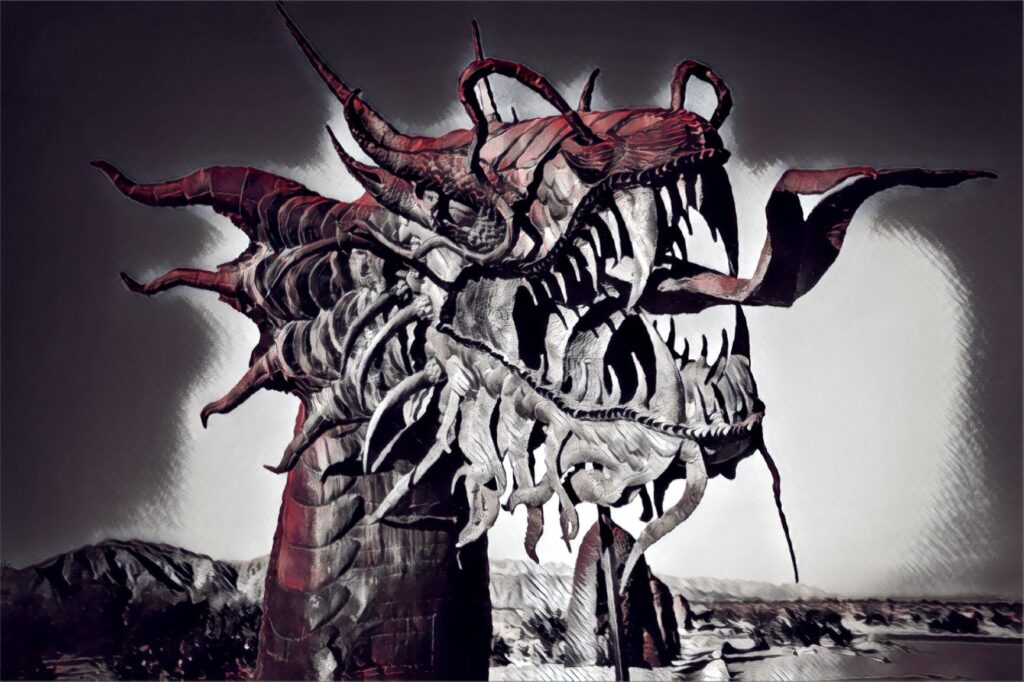
Editor’s Comments/Image Credit: Indeed, this dragon is god-like, and a precedent for this image goes to “leviathan” in the Old Testament, as well as “that old dragon” in the New Testament, which may be metaphors for the enemy, both physically and spiritually.
The kyrielle is also known as a narrative ballad (which I think is redundant). Interestingly, consistent with what Michael points out, the name of this form is a compressed version of the Greek clause kyrie eleison (Lord, have mercy).
It’s worth noting that there are several poetic forms that lend themselves exceptionally well to the narrative, like the ballad, but even more so, the sestina, which is often very prosy (but can be quite poetic if it is filled with other poetic devices beyond the prescribed repetition of the 6-end words in each of the six-line stanzas). I find that the Golden Shovel, which is “easier” to write than a sestina, is another avenue for a narrative poem. But remember, the narrative poem doesn’t necessarily mean poetic prose. See Elizabeth Bishop’s work for a lesson in writing a narrative poem with lyrical intensity (especially “The Fish,” which you can read here: https://poets.org/poem/fish-2).
The base image is a photo by Leo Visions on Unsplash,* published on September 10, 2020 (UTC) Canon, EOS 5D Mark IV. Subsequently filtered for mood with Prisma using the Daryl Feril filter by the Editor.
*Free to use under the Unsplash License