
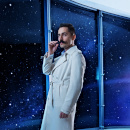
 The Elevator Case
by Kit Gadgitar
We could see five planets and an infinite number of stars, but no one cared because they needed the restroom.
“EEC can’t just hold us here.” I crossed my legs, stiff from four hours confined to a black leather recliner.
My older brother shrugged, twiddling his seat belt. “There isn’t common law in a space elevator.”
On the first day of the three-day elevator trip, we had been free to walk around. However, most people chose to remain seated. From our comfy passenger chairs, we could watch movies, order food, and gaze out massive windows at the majesty of space.
Now that, on the second day, we were forced to remain seated, we resented it. Kids whined, parents grumbled, and one-star reviews went up like the number on a thermometer drifting toward the sun.
We sat in a circular arrangement, the layout of the main cabin reflecting the cylindrical shape of the space elevator. Our seats faced outward toward floor-to-ceiling windows, where black space broke against the white tile floor. Behind us, an elevator within the space elevator connected us to the vehicle’s other levels.
Five guards with EEC—Edison Elevator Company—emblems on their shirts stared at us. One stood by the central elevator shaft, monitoring the exit. The other four stood at opposite ends of the cabin, blocking the restrooms. They had ordered us to remain seated without any explanation except for the black holsters on their navy uniforms. My bladder felt about how you’d expect.
Ellsworth smiled his bad-idea smile, scrunching his wispy mustache up into his nostrils.
“Oh, you’re not thinking of that are you?” My fingernails dug into the foam padding beneath my chair’s leather skin.
“Yes, I’m thinking of that.” He spat into his hand and spiked his wavy black hair.
“Ellsworth, you graduated from one of the best schools in the galaxy, and you decide to spend your time doing that?” I hated how he made me, his twenty-year-old little sister, sound like mom.
Ellsworth turned up the collar of his khaki trench coat. “If you don’t intentionally lead an adventurous life, you sink into a dull one.”
“You mean a long one?” I asked.
But Ellsworth wasn’t listening. He flagged down the nearest security guards. “So it’s murder, then?”

The guard brought us to the staff quarters, a gray cafeteria-sized space with a low ceiling and numbered dorm rooms along three flat walls. One of the dorm doors was open, leaking the scent of popcorn and the sound of an old movie. The fourth wall wasn’t actually a wall at all but rather a curved window, reflecting the cylindrical shape of the space elevator.
Like the other floors, the interior elevator within the space elevator ran through the center of the room. Our guard took us from the interior elevator to a white conference table by the window.
We sat down, and I placed my hands on my lap after an abortive attempt to use my stiff chair’s uncomfortable armrests. Around us, the only two rooms that weren’t dorms were the kitchen to my right and the restroom to my left. Somehow, the urge to be polite (and not get shot) won out and I did not dash to the restroom.
Including our original guard, a total of three staff members rounded on us for questioning. Unfortunately, or, perhaps, fortunately, our interrogators seemed to have never interrogated anyone before.
After five minutes of Ellsworth explaining he had “just guessed” that someone was dead, the guard muttered something about getting back to guarding and a woman wearing a chef’s hat said she needed to make soup. The two hustled out the door, leaving behind a scruffy man in a black t-shirt.
He walked over, gracing us with the smell of unwashed beard. “Remind me again, how did you know about the death without seeing any evidence?”
“I’m a detective,” Ellsworth said.
“He’s a lawyer,” I said.
“We could use a detective,” the scruffy man replied. “HQ wants us to make sure no one else dies before landing.” The traces of competence in his voice were surprising, given his haven’t-done-laundry-in-two-weeks outfit.
“My rate’s sixty credits an hour,” my brother said without hesitation.
The scruffy man turned to a gleaming silver ball at the center of the table. “Hey, can we hire him?”
A hologram shot out of the top of the ball, a cloud of flickering ocean-colored pixels that coalesced into a rippling blob. The blue particles morphed into a pair of shoes. Then trousers. A suit jacket. Arms. Hands. The face of a man. Digital eyes stared back at us. A mouth appeared. Speakers crackled to life. The man’s lips parted.
“Sure.”
The hologram clicked off, and the table went back to being a table.
“Well, the boss approves.” Our former interrogator put out his hand. “I’m Eddie, the maintenance engineer. I mostly hang out here.”
My brother stood up from his chair and shook the engineer’s hand. “I’m Ellsworth, and this is my lackey—”
“Sister,” I coughed.
“—Lin.” My brother continued, “First, tell us what you know about the death.”
“Hold on,” I interrupted. “Did you say ‘us’? I’m not part of your game.”
“One moment, please.” Ellsworth dragged me a few yards away to the window beside the kitchen door. Pots and pans clattered through the wall. He lowered his voice. “I don’t want to leave you alone if there’s a killer on the loose, Lin.”
“It sounds like you want to take me directly to him,” I whispered back.
“Don’t you want to do something exciting for once?”
“I’m more than entirely content with my stable career path.”
“You can’t even do anything with your degree unless you do graduate studies, post-graduate studies, post-post graduate studies, and a stipend-less residency in the most expensive city conceivable.”
I glared at Ellsworth for a respectable eight seconds and took a deep breath.
“I’ll help if they let us use the restroom.”
The first-class cabin was conspicuously comfortable. The floor was the same size as the main cabin but hosted a fraction of the passengers. The extra space was used for private suites, a sauna, and a fully-equipped gym. Although the concepts of north, south, east, and west are dubious for space travel, the terms are still useful for describing two-dimensional areas. The suites occupied the east and west of the cabin, the restroom and sauna occupied the north, and the gym occupied the south. The whole floor also seemed to smell better than the others, perhaps because of the open buffet on the dining table by the sauna.
Of course, our trip’s standard-model Edison Space Elevator wasn’t a true luxury elevator. Here’s what Galaxypedia has to say about luxury space elevators:
The premiere luxury elevator is Goldiman’s Boutique Triple Deluxe Elevation Experience. What sets Goldiman’s apart from its competitors is that it contains a forest of highly-evolved pine trees who speak English and will tell you what it’s like to be made of wood.
Where do luxury elevators go?
Nowhere. They’re too big. Ever since Goldiman’s Boutique Double Deluxe Elevation Experience got hit by an asteroid while simulating a rural medieval village, real luxury elevators have been forbidden to leave orbit.
Only lightweight elevators, which can slide up and down their cables fast enough to avoid flying objects, are permitted to travel.
We were on a lightweight elevator. Where was it going? Where did it come from? Those facts aren’t relevant to the case. Also, I don’t want to get doxxed.
What is relevant is that Mickey Bresson was found dead on the toilet. No sign of violence. No heart attack—just a slumped body.
Frankly, no one had evidence it was a murder. I think the staff was treating it like one because they didn’t want to live in a world where healthy people randomly die passing gas.
That night, only half the first-class passengers came to the dinner table. This was partly because one of them was dead and partly because the others wanted to eat in their rooms.
Of the remaining passengers, we met Prince Mupert Moonsly, Renay Blanc, and Miss Blanc’s three silent children. Moonsly and Blanc were about thirty, and the kids were young enough to be shorter than the table.
We sat down in elegant little metal chairs and spoke over a course of chicken piccata. The tender meat drowning in lemon cream and capers did wonders for my mood.
“It’s safer eating here.” Blanc tipped her fork in the direction of the armed guard posted by the door. “I don’t understand why everyone else is in their rooms.”
“Your children seem to be handling the situation well,” I chimed. “The kids downstairs have been hollering all day, and our cabin doesn’t even know about the death.”
Blanc threw back her long straight black hair and laughed. The pleasant, if not slightly cutting, sound echoed through the quiet cabin. She wore a gray dress with jeweled pyramids at the shoulders. “Oh, these aren’t my children. I’m their governess. I keep them sedated at times like this.”
“Sedated?” Ellsworth raised an eyebrow. He examined the faces of the children. Their dilated pupils stared back. Empty.
I lowered my lemon-scented fork.
“Oui.” Blanc’s merlot-colored lips formed a thin smile. “Helps them feel what it’s like to react with composure to death. They’ll need to react with composure to everything one day. They’re going to lead planets. Solar systems.” She patted a little boy wearing a pinstripe suit. “Maybe the entire universe if they play their cards right.”
The children ate chicken nuggets without emotion.
My brother shifted his attention to the other man at the table—Prince Moonsly.
Light brown bangs tumbled over the prince’s forehead. He had a round, almost chubby face with navy blue eyes that matched the color of his jacket. It was difficult to tell Blanc’s exact age because of her makeup, but I would estimate Moonsly was twenty-eight.
“And what about you, Your Highness?” Ellsworth said.
“Oh, don’t call him that,” Blanc said. “His father bought him a small astronomical object, and now he goes around acting like some moon prince.”
Moonsly shot her an unappreciative look. “Well, how did your kids get their titles?”
“Their parents’ planets have infrastructure. Citizens. Government.” She enunciated each word with pride. “No one lives on your moon. No one even lives on the planet it orbits.”
Moonsly tightened his grip on his knife and fork and stared down at his plate.
“Did either of you speak to Mickey Bresson before he died?” Ellsworth continued.
“No, I’d never let the children near that degenerate,” Blanc hissed.
“Yes.” Moonsly perked up. “We chatted over drinks at lunch yesterday. And over drinks at dinner last night. And over drinks at… erm,” he glanced at Blanc, “drinks at breakfast this morning.”
The governess shifted her sharply contoured dress and hissed “degenerate” again.
Moonsly puffed up his cheeks. “I don’t normally do that sort of thing. He was just a fun guy.”
“What did you talk about?” Ellsworth prodded.
Moonsly chewed his food thoughtfully. “Everything really and nothing at all. He worked for Rum Runners Intergalactic. Wanted to know if there was a liquor store on my moon. Then we moved on to all sorts of random subjects.” He glanced toward the closed bedroom doors. “The Luneburgs and Rhinebar were there too.”
Mickey Bresson died in the men’s first-class bathroom accessible only to first-class passengers. Henry Rhinebar had reported the death, so, naturally, we went to him first.
Ellsworth knocked on Rhinebar’s bedroom door. The engraved faux wood panel slid open after a long minute.
Rhinebar towered over us in silk pajamas that matched his corn-yellow hair. I caught a faint whiff of body odor and a glimpse of the messy bed behind him. Rhinebar’s amber-brown eyes gave us a few half-hearted blinks before he yawned, said he wouldn’t speak without a lawyer, asked if he was being detained, and shut the door.
Since we couldn’t interview Mr. Rhinebar, we stood there and searched his name on the internet. He had the typical rich twenty-two-year-old backstory: parents with a monopoly over some product on some planet out in the middle of somewhere.
I couldn’t blame Rhinebar for not wanting to talk to us. As one of the only people who regularly entered the first-class men’s bathroom, he was our prime suspect.
We knocked on the bedroom door of the remaining two first-class passengers, and they invited us right in.
“An investigation? Fascinating.” Loretta Luneburg pulled out chairs for us at a tiny glass table and ordered tea to the room. She was an unusually energetic older woman. Shoulder-length hair, bright eyes, and quick movements. I took a breath and pegged her as the source of the fruity perfume filling the space.
Unlike Rhinebar’s suite, the Luneburgs’ quarters had a second twin bed on the opposite wall from the first. This left little room for the dining table, but Ellsworth and I still managed to cram ourselves in and sit down.
Who I presumed was Loretta’s daughter sat on the edge of her beige bed. She maintained a polite, reserved smile. The girl was a cartoon princess: early twenties, long blond hair, billowing royal blue dress. Her mother looked like an older version of her but acted younger.
Loretta hung up the room service phone. “Shame about Mickey. Seemed like the type who could get along with anyone.”
Ellsworth thanked her for her hospitality and asked what she did for a living.
“We’re the Luneburgs.” Loretta smiled radiantly.
I nodded without understanding. I could look up the name later. So many families were claiming arbitrary terrestrial bodies and acting like aristocracy that it was difficult to keep track.
“And what brings you on this trip?” Ellsworth asked.
“Luna,” Loretta gestured to her daughter, “is getting married to Henry.” She waved her other arm in the direction of Rhinebar’s room. “We’re going to the wedding.”
Luna nodded and stared at me for whatever reason. Maybe we were both wondering if we were the same age.
“Congratulations,” I said to the vague space of air between Luna and her mother.
“Everything is going to be beautiful.” Loretta shined like a tulip in the sun. The tea arrived. Light brown with a generous amount of milk and sugar.
My brother turned from Loretta to Luna. “Are you excited to marry Henry?”
There was a brief silence.
Luna answered, “He’s nice.”
Another silence. No one sipped their tea. My cup steamed in my hand.
Loretta picked up, “It will be a fine union of families. The Luneburgs and the Rhinebars. Everything is going to be beautiful.”
I congratulated the mother of the bride again.
“Now, about the case, did you speak to Bresson at all?” Ellsworth asked.
“Yes, at dinner last night and breakfast this morning,” Loretta said. “Although I was absolutely astonished he was able to wake up.”
Ellsworth made an inquiring noise.
“He stayed up far later than us drinking.” Loretta clicked her tongue. “I don’t drink because of my medicine—not that I could drink as much as him anyways.”
“So he talked to both of you last night. What about?” I took a sip of tea and smiled as the warm, sweet liquid caressed my throat.
“Oh, you know, introductions. He was a top liquor salesman. Told a wonderful story about playing a drinking game with an alien only to realize their species couldn’t get drunk.” She started to laugh but caught herself and adopted a more somber expression.
“Anything else, Luna?” Ellsworth asked.
The girl shook her head.
“Well,” Ellsworth put down his half-full cup, “it’s getting late. We should let you sleep.” He rose.
“Oh, it’s really no trouble.” Loretta stood up. “I do hope you catch the criminal. Mickey was so nice. He really did get along with everyone.” She crossed the room in a few steps and opened the door. “Even the maintenance worker.”
My brother and I glanced at each other. Eddie?
Maintenance engineering aboard an Edison Space Elevator is one of the most monotonous professions in the universe. An engineer’s primary responsibility is to confirm the nuclear reactor powering the elevator is not exploding. This explosion rarely occurs, and when it does, the maintenance engineer is often too dead to do anything about it.
An engineer’s second responsibility is to enter the control room and manually stop the elevator if it’s on an unforeseen collision course. However, pathfinding artificial intelligence has advanced to a point where collisions are as improbable as winning the Earthly lottery three times and subsequently being kidnapped by a committee of upset statisticians who can’t accept your existence.
An engineer’s third responsibility is to be generally helpful and fix mechanical things. Maintenance engineers are unlikely to perform this duty because space elevator trips only last a few days, and ground crews fix everything at landing. The only exception to this rule is the stove. A maintenance engineer will always fix the stove because, without the stove, the chef will not make him food.
As a result of these environmental forces, space elevator maintenance engineers are some of the most sought-after kitchen appliance repair people in the galaxy. They are also incredibly likely to take bad suggestions from passengers if it will make their lives minutely more interesting.
I read the Galaxypedia passage on my phone as we rode down to the staff quarters. The elevator chimed, and the brushed metal doors opened. Ellsworth and I stepped out onto the gray level. We passed the white conference table and walked along the wall of dorm rooms until spotting Eddie through a half-open door.
“Oh, hi.” The engineer propped himself up on a pillow, nearly spilling his bag of popcorn. The room smelled like his snack.
Eddie lay on a navy comforter, still half-watching television. Hover car engines growled from the speakers at the foot of his bed. On the wall to his side, picture frames hung above a dented plastic dresser. Vibrant illustrations of purple and green planets disrupted the monotone walls. The tiny room lacked chairs, so Ellsworth and I posted up against the wall. I leaned back, unintentionally covering the poster of a band that was popular ten years ago.
“Did you speak to any of the first-class passengers?” my brother asked.
Muscles tensed on Eddie’s sinewy arms. He stared past us at the doorway.
“I’ll remind you that withholding information will look very strange if we end up in court.” Ellsworth stepped forward.
I frowned, unable to remember the last time I had heard my brother sound… intimidating.
The engineer paused the television, cutting the noise. He let the remote fall from his hand to the bed. “Only Mickey.”
My brother continued, “When did you speak to him?”
“The first day of the trip, on the maintenance stairs.” Eddie put down his popcorn. “I don’t normally see passengers there and asked if he needed help.”
“What did you talk about?” I tried not to sound too eager.
“Mickey said he was looking for ‘a place where a man could get privacy’—a place without security cameras. ‘Your room?’ I said. But he asked for somewhere away from the other passengers. I mentioned the engine room by the nuclear reactor…” Eddie lay back on his pillow and stared at the formless gray ceiling. “He… somehow persuaded me to leave the engine room door unlocked.”
We stared at Eddie skeptically until he was uncomfortable enough to keep talking.
“Mickey gave me some drink coupons.” A grim smile appeared under Eddie’s dark beard. “Now you know why I’m rooting for you to solve this and avoid a full investigation.”
“How many coupons?” I leaned forward off the smooth wall.
“Seven hundred.”
Like attending my first frat party, I wasn’t sure if I was disgusted or impressed.
Eddie must have caught my expression. “Yeah, not like I can do anything with them this month. Doctor prescribed me some meds that don’t mix with alcohol.” He plopped popcorn in his mouth. “God, there are so many meds that you can’t take with alcohol. I gotta wonder if they actually make people better or if people get better because they stop drinking.”
“Excellent observation.” Ellsworth smiled, and the tension evaporated from the room.
“No pressure if you guys can’t solve the case.” Eddie reclined back on his pillow. “Got some competitive job offers in stove repair far away from here.”
“Is that a good business?” My brother tilted his head.
Eddie offered him the bag of popcorn. “If the universe is infinitely large, then there are infinitely many stoves.”
Ellsworth asked Eddie for a Geiger counter. I had no idea what that was, so I searched the term on Galaxypedia while we rode the central elevator.
A Geiger counter is a device that measures radiation. The apparatus was first conceived by Hans Geiger in 1908 (Earth years). Although the device is widely admired for being bright yellow, some have suggested that instead of measuring radiation, humans simply not irradiate things. Indeed, neighboring galaxies have insisted humanity adopt the accepted practice of generating unlimited energy by spiking compost piles with English breakfast tea. Unfortunately, humans ignored these requests in order to partake in their traditional pastime of pointing large missiles at each other.
Ellsworth knocked on the Luneburgs’ door.
“Hello, dears!” Loretta opened the door with zest. She didn’t flinch as Ellsworth waved the bright yellow Geiger counter.
4 mSv. Normal.
“Sorry about that. Just testing the air.” Ellsworth lowered the device. “So the wedding’s in a few days?”
“It’s tomorrow. My husband’s already arrived at the venue.” Loretta laid out porcelain plates. The aroma of fresh peaches filled the room as she cut slices of fruit cake. “He needs a license from Henry’s father to sell whatever it is they sell. But, yes, the wedding will be spectacular. We can’t always afford a trip like this.” Her fluttering laugh bounced off the walls.
Luna walked over to the glass table, her floral-print dress swishing gently. Ellsworth pointed the Geiger counter at her, and the device beeped.
20 mSv.
“Would you mind if we borrowed your daughter for a chat, Mrs. Luneburg?” he asked.
“Yes, I would.” Loretta put down the serving knife. Her smile was gone.
“We only want to ask some questions,” I said, thinking the request was innocent enough.
“You can ask them here,” Loretta replied.
Luna’s blue eyes grew large. Cake quivered on her fork.
My hand unconsciously sought the door’s plastic handle.
Ellsworth shrugged and turned to Luna. “What were you doing in the nuclear reactor chamber with Mickey Bresson?”
“Impossible. My daughter would never go off with that man.” Loretta swept in front of Luna.
“I didn’t do it!” Luna pleaded from the cramped space behind her mother.
Ellsworth gestured toward the Geiger counter and opened his mouth, but Loretta cut him off.
“Listen, whatever that is, don’t jump to conclusions. Interview the governess, Blanc. She pumps those kids full of drugs every day and could have easily done the same thing to Mickey.”
“Why would she do that?” I shot back.
“You didn’t recognize the three kids? They’re the Sauvignon children. Heirs to Sauvignon Étoile Inc. The largest wine and spirits manufacturers in the galaxy.” Loretta slowed down, emphasizing her words. “Direct competitors of Mickey’s company, Rum Runners Intergalactic.”
“All right,” Ellsworth stepped halfway out the bedroom door. “I’ll check your story, but security will be posted outside.”
“We’ll be right here when you prove us innocent.” Loretta pressed her palm against her forehead. “My God. How stressful. Luna, can you get mommy’s medicine?”
We found Blanc and Moonsly at the dining table.
“How goes the investigation, detectives? Would you like a glass of wine?”
Renay Blanc and the three children were eating lunch with Moonsly. We sat down, and I swiped a coconut, cardamom scone from a wicker basket on the table. The sweet crunch of coconut flakes blended with mild spice was delicious.
“I wonder if you could appreciate this, Moon Man.” Blanc poured Moonsly a glass of transparent liquid. “What do you taste?”
Moonsly put down his sandwich and took a sip. “White wine.”
Blanc’s expression contorted into something between contempt and pity. She swirled her glass and raised it to her ruby lips. “Pinot Grigio. Hints of lemon, lime, and apple. Green apple. Dry, mineral flavor.”
“I don’t like talking to you.” Moonsly put down the glass.
“Renay,” Ellsworth murmured in a meaningful tone, “I’d like to speak about the investigation.”
“Children,” Blanc said sharply, “to your rooms.”
The little ones stood up and walked away with the dignity of fifty-year-old monarchs.
“The Sauvignons compete with Mickey’s company, Rum Runners Intergalactic.” Ellsworth trailed off.
“Where are you going with this?” Blanc crimsoned with anger. “I couldn’t have done it. I never set foot in the men’s restroom.”
Moonsly scooted his chair away from her.
Ellsworth pressed, “You could have administered sedatives, or you could have hired someone. Rhinebar, Moonsly…”
“I watch children, pour l’amour de Dieu! The Sauvignons have never asked me to conduct corporate espionage.” She rose from her seat and pressed her hands into the table. “As for the men you named, Rhinebar is too rich to hire. And Moonsly—”
Moonsly interrupted, “I wouldn’t do it myself.”
Blanc’s mouth clamped shut.
Moonsly continued, “My father, King Blackmoon of Blackmoon Mercenary Co., has a diverse staff of galaxy-leading assassins. We have an 87% success rate and offer overwhelming force at an affordable price. Papa would be offended if I didn’t use his tools.” He shrugged and finished his sandwich.
Ellsworth waved his Geiger counter at the governess and the prince.
4 mSv. Normal.
“Really, you should be talking to the Luneburgs. Mickey and Luna were awfully close together at the gym the morning of the death,” Blanc said.
Moonsly added, “Mickey told me all about his conquests with women. And he named some famous names.”
My brother and I sat down with Eddie at the conference table in the staff quarters. The chef walked by with a pot of orange soup. Ellsworth massaged his wispy eyebrows and spoke only after the aroma of boiled potatoes had disappeared through the door.
“I have a few theories, but I need more information. Do we have any background on the Luneburg family?”
“No,” I said. “When I searched them on the net, unrelated people named ‘Luneburg’ popped up.”
“Then, the only person who has a motive to kill Bresson is Blanc. Was there any security footage of her near the victim or the men’s restroom?”
Eddie tapped the conference table. “Computer?”
A chime reverberated from speakers around the table, and a few seconds later, a digitized voice said, “No.”
“What about her kids?” Ellsworth asked.
I frowned at him.
After a few moments, the computerized voice repeated, “No.”
I jabbed my brother in the ribs. “So it wasn’t Blanc, and it wasn’t power-hungry school children. Did the killer have no motive, or are you going to admit it wasn’t a murder?”
Ellsworth shook his head. “Moonsly and Rhinebar seem to have no connection to Bresson, but we don’t know enough about the Luneburgs.”
“You think it was the Luneburgs?” I asked.
“One Luneburg.” He went quiet.
I waited, watching the creases in my brother’s forehead ease and tense.
Eddie checked his watch. “Stop holding your sister in suspense.”
I glanced over at Eddie. “He’s not holding me in suspense. He’s holding you in suspense.”
“Cut it out, Lin. I’m holding both of you in suspense.” Ellsworth stood up and walked over to a long window. His khaki trench coat formed a reverse silhouette against the blackness of space. “What happened was… Actually, we ought to go to first class and tell everyone at once.”
Eddie stood up. “That’s a great idea.”
I stood up. “That’s a terrible idea. Won’t they just deny everything and yell at us?”
But Eddie and my brother were already walking to the elevator.
When we arrived at the first-class floor, Moonsly and Blanc were still sitting at the dining table. Moonsly nibbled a scone, making little crescents in his round cheeks. Blanc watched us with hawk eyes and gestured for her kids to leave.
Henry Rhinebar came out of the men’s restroom in a plaid blue suit. His tall figure made a beeline to his suite the moment he saw us.
Ellsworth called out, “Are you sure you don’t want to stick around to hear who did the deed, Henry? You might be surprised.”
Rhinebar looked over his shoulder. “My only comment is that I have no comment.” He disappeared behind a sliding white door.
We walked toward the dining table, and Ellsworth motioned for the guard to let the Luneburgs out of their room.
Loretta strode out, hands on her hips, short heels clicking against the floor. Luna followed in quick quiet steps.
“Finally found your senses, detective?” Loretta took a seat at the opposite end of the table from the others.
“If I were you, I’d be concerned he found something else.” Blanc applied lipstick to her smirk.
“Oh shut up, you snobby wine woman,” Loretta snapped. “You’re the only one with a motive, and maybe Prince Mini-Moon even helped.”
Moonsly lowered his pastry. “Accuse me again, and you will be hunted.”
“See detective?” Loretta whipped around to face us. “He just threatened me.”
Ellsworth pulled himself a chair at the center of the table. “She’s right, Moonsly. You really shouldn’t do that. Regardless, now I’ll tell you all how Mickey Bresson died.”
Eddie and I stood, flanking my brother. I hoped the two guards by the central elevator would be enough help if things turned violent.
Without further ceremony, Ellsworth said, “Luna snuck off with Bresson because he was charismatic, and she’s not in love with Rhinebar. They went on a date to the elevator’s nuclear reactor for privacy, and it left a bit of radiation on her, which we caught on a Geiger counter. The next morning, she heard Mickey bragging about his adventures and realized she was one of them. But she’s getting married tomorrow,” Ellsworth pointed toward Rhinebar’s cabin, “to Henry.”
Ellsworth swiveled his chair toward the Luneburgs. Loretta gripped the edge of the table, red as a cherry. Luna’s hands remained folded on her lap, icy sapphire eyes staring straight ahead.
“We researched your family, and nothing came up. You’re probably rich but not rich enough for anyone to care. The marriage with Rhinebar was your ticket to power. Luna couldn’t let Mickey’s blabbing ruin it.”
“But how did she do it?” Moonsly looked over at Luna.
“Slipped her mom’s medicine in Mickey’s water bottle while they were working out together. Loretta doesn’t drink because her drugs don’t mix with alcohol.” Ellsworth turned to Eddie. “I get the impression Bresson was more or less drinking constantly.”
“Constantly.” Eddie nodded.
Blanc cackled at Loretta. “You should have sedated your child!”
The Luneburgs proceeded to deny everything and verbally assault us for five minutes until the guards took them away in handcuffs.
We stood before an enormous window stretching across the wall. The emerald planet in the distance grew larger and larger. Other passengers wandered around the main cabin behind us, stretching their legs.
“So it’s over?” I said.
“We’ll have to give testimony.” My brother pulled me into a side hug, and my cheek pressed against the rough fabric of his coat.
“Why did you do it?” I tugged his sleeve. “You make more money as a lawyer. And, now, the Luneburgs might try to hurt you.”
“How did you feel about the case once you knew there had been a real murder?”
My eyes traced the green continents spinning gently outside the window. “Like we weren’t being silly anymore. Like nature doesn’t make justice happen, and we have to do it ourselves.”
“No, Lin. Nature does create justice.” He stroked down my hair. “After all, nature makes people like me. Or maybe…”
The elevator slowed for atmospheric entry. The other passengers sat down and clicked on their seatbelts.
Ellsworth smiled down at me. “People like us.”
_______________
Kit Gadgitar is a bio-less being. For updates on the author’s non-activities, subscribe to https://kitgadgitar.substack.com or check kitgadgitar.com.