
 Lifeline
by D. M. Riemer
The tabletop in the fourth-floor conference room was normally plain white laminate, but this afternoon it displayed the surface of Mars. Most employees would recognize the orbital view of Valles Marineris, pointing squarely at the peaks of Ascreus, Pavonis, and Arsia. As an original painting it was admirable, but sadly limited to shades of milky brown. It was also a bit runny, the result of being executed entirely with coffee.
Dana dipped a finger in her nearly empty cup and began adding the broken highlands of Noctis Labyrinthus. Given enough time, and enough coffee, she could probably cover the entire table with Martian geography. She’d spent much of the last seven years looking at it.
Painting, even with coffee, was good. Painting helped alleviate anxiety, which right now threatened to consume her. She’d much rather have some of her nice Richeson watercolor paper, the Winsor and Newton paints, a set of proper brushes, but coffee and a table were better than nothing. In her workspace, even on her console in the operations center, Dana displayed dozens of small watercolors, her attempts to capture the native plants of the southern California chaparral. Her colleagues called her flower girl, a sobriquet she wore with pride. The local plants were magnificent life, hardy and dependable, and wasn’t that what they were all trying to bring to Mars?
The last of the coffee, long cold, went down her throat. A full 16 ounces of dark roast Sumatra may not have been the best idea, under the circumstances. Dana leaned back, stretched, and spoke to the security man standing near the door.
“I have to use the lady’s room.”
The man muttered something to an unseen listener; he was wearing an earpiece. A moment later he looked at Dana. “They’re sending someone.”
Dana shifted, crossed her legs. She’d been in the conference room for over two hours. She had a pretty good idea of what was happening but didn’t expect it so soon. Tears began to dot the corners of her eyes, again.
“I don’t need a chaperone to pee.”
The man stared at her.
She spun out of her chair and strode toward the door. The man moved to block her exit and spoke with unexpected gentleness. “They’re sending someone.”
Dana crossed her arms and tried to project righteous anger. “This is bullshit.”
But she backed away and paced around the conference table, which made for a fairly long stroll; it could seat up to forty. Reaching the floor-to-ceiling windows, she stopped and looked out over Burbank, traffic crawling up the 5 in the twilight. Anxiety was spreading out from her stomach, up her chest. She knew from long experience that it would land in the base of her neck and explode into a killer headache that might last a week.
After sending the message, Dana had hoped for at least a day of more or less normal work, but the story had leaked in under 12 hours. Dana had confided with no one on earth, so someone on the Shushi no Saya must have sent it back to mission operations. Serious shit was about to come down, a rain of shit, the shit of legends. She had known the risk and had tried to prepare herself for the fury of Red Delta’s managers, scientists, and engineers, to say nothing of the legions of academics who would find her action beyond ludicrous. Then there was the news media. Oh, my goodness, they would have such fun with her, like cats with a legless chipmunk. Dana could imagine the memes now, circulating for all time, amusing clips that paraded her as a crackpot, a fool, a traitor. The word “unhinged” would certainly be used. She didn’t think anything could save her career and began to wonder just how vindictive Red Delta would be. It could get bad. She could lose her house. Hell, she could go to prison. This made her think of a former roommate at Stanford, Rebecca Moore. Junior year, Rebecca had switched from engineering to pre-law and was now a ferocious litigator in San Francisco. They hadn’t stayed in touch, but this was probably a good time to reconnect.
A tall Latinx woman arrived at the door. Like the man, she was kitted out with a black polo, khaki trousers, and an earpiece, the livery of modern corporate security. She called across the room to Dana. “Let’s go.”
Willing her bladder to behave for another minute, Dana moved to the door, trying not to look like she was hurrying. As they left the conference room the man fell into step four paces behind them. The lady’s room was north along the hallway, on the right. The female guard pushed through the door.
“Wait,” she told Dana, who groaned again and managed an indignant “Really?” The guard returned and beckoned Dana inside. The guard pointed to the first stall. “Here. Door open.”
“I will not pee with you staring at me!”
“Yeah, you will.” Stony, utterly inflexible.
Dana cursed, pulled down her pants, and gave her bladder much needed relief. The sound seemed like the loudest thing she’d ever heard, but it sure felt good. Dana locked her eyes on the floor.
“People are talking about you,” the guard said.
“What are people saying?”
“That you convinced the crew to use up their food supply. The food that’s supposed to keep them alive after they land, for two years. So now they’re all gonna starve.”
Dana nodded and the tears came in a flood. “Yep,” Dana said. “That’s exactly right.”

The first mission to Mars carrying a human crew was a fluke, a vastly improbable confluence of capital, technology, and ego. The capital flowed from a consortium spread through China, the United Arab Emirates, India, and, curiously, Mexico. (The fact that the Mexican concerns were thinly disguised drug cartels seemed to trouble no one.) The technology came from South Korea, where a daring startup had patented a next-generation rocket engine. The ego came in the form of Japanese businessman Hideo Nakadai. He wasn’t the richest of Japanese oligarchs, not by a long shot, but he craved immortality with a visceral sort of hunger, yearning to put his name on something utterly new. Movie star handsome, fluent in five languages, he jetted his way from meeting to meeting on three continents. After two years, he had put together a deal that left existing aerospace leaders wondering who had just eaten their lunch. The group announced its IPO as Red Delta, Inc., with a goal of landing humans on Mars in ten years. Nakadai already had a name for what was then an entirely fanciful spacecraft: Shushi no Saya, Japanese for seed pod. Well, okay, but who cared? Mars? Really? A mission to Mars was pointless! Please refer to the earlier point about ego.
Dana was mopping up the Mariner Valley with a wad of paper towels when a thundercloud swept into the conference room in the person of Robert Saperstein, Red Delta’s Managing Vice President, a much bigger fish than Dana expected to see today. In direct mission and flight ops, Dana was fully in charge, but the broader corporation was another matter; there were probably 30 different people who could fire her. Robert was one of them. He looked like he’d just stepped out of a firefight, which in some sense was probably true. His face was unshaven, oily, his hair poking up like an October cornfield. He plopped into a chair next to Dana.
“So, who are you really?” he asked, voice husky with exhaustion. “Just who the fuck are you really?”
Dana looked away, went back to cleaning up her coffee art.
Robert leaned closer. “You look like our Stanford PhD ops chief, but she wouldn’t do what you did, so you must be some impostor. Right?”
He sounded strange, burned out, but something else too; Dana wondered if he was high. She sat down, looked away. There were no moves, no escape plan. She was a bug in a box and Red Delta owned the box. It was probably simplest to just face the music. Dana took a deep breath.
“Any questions?”
Robert choked out a grim laugh, sat back, ran a hand over his oily hair. “I already asked you one. Who are you?” He let the silence stretch, and really seemed to expect an answer.
“I’m Dana Kartelius, your lead operations engineer.”
Robert shook his head. “Oh, no, no, that’s in the past. You were terminated about two hours ago.” He turned toward the door. “Carmella!” Three suits strode in, one a fiftyish, olive-skinned shark on four-inch heels who Dana recognized as the company’s general counsel.
Staring at Dana, she handed Robert a folder without a word. He flipped it open and, one by one dropped dense legal documents on the table.
“This,” Robert began, “is the notice of your termination for violation of your NDA and unauthorized use of company assets.”
“I didn’t violate my NDA. Everyone on the crew is a Red Delta employee.”
Robert ignored her. “This,” another document joined the first, “is a gag order, signed about half an hour ago by a federal judge. It prevents you from discussing any aspects of the Shushi no Saya mission, or any Red Delta plans, activities, or operations, with anyone, in perpetuity. And this,” a third document appeared in Robert’s hand, “is a restraining order, signed by the same judge, which triggers an automatic warrant for your arrest should you come within one hundred yards of any Red Delta facilities, or communicate—”
“This is insane.”
“OR COMMUNICATE, with any Red Delta employee. In case it isn’t obvious, that includes the crew on the Shushi no Saya.” He dropped the third document on top of the others. He leaned back and suddenly seemed to deflate, to collapse inward, as if the completion of Dana’s ouster had consumed the last of his energy. He rubbed his face, spoke through his hands without looking up. “Why did you do it, Dana? With all the shit we were already facing, all the rumors, all the fucking tragedy, why did you do it?”
Robert already knew the answer, but she said it anyway. “Because they were all dying.”
He snorted at this, stood up. “Well, since the ship has gone dark at your suggestion, the medical team figures they’re all dead anyway.” Robert stood, exhaustion pouring off him like bad karma. “Six words, Dana. Six words. And you pulled this entire corporation to the ground.” He spoke to the guards. “Escort Doctor Kartelius to her car.”
Riding the elevator to the top of the parking deck, shadowed by the two security guards, Dana felt sure a gun would be pressed to the back of her head any minute, followed by a shot she wouldn’t hear. Okay, too many movies. Yet Saperstein’s anger had been so raw, so consuming. He wasn’t simply enraged; he had felt betrayed, and she couldn’t blame him. But he wouldn’t have her shot in a company elevator. Too messy. Besides, companies like Red Delta had other ways to destroy her, to make her decision torture her for the rest of her life. She wondered how it would feel being homeless, joining the legions of the lost in downtown LA.
Outside the elevator, Dana walked into the fading daylight heading for her car. Her mind raced in a hundred directions, consumed by a chaos of memory and imagination, wishes and dreams, actions that had lain clearly in her future just hours ago and were now pointless dead ends. The noise of traffic on the 5 began to push against her with an almost physical force.
Dana had always been struck by the inevitability of Red Delta’s headquarters location. Though there wasn’t a single American investor involved, California exerted an irresistible pull on the big aerospace projects. It was simply impossible to ignore the concentration of talent. The world’s best engineers, researchers, and technicians could all be found in this one spot. Space X was just 25 miles south in Hawthorne, NASA’s Jet Propulsion Lab 10 miles east in Pasadena. Southern California was Space Land, and Dana didn’t think that would ever change.
She reached her battered Volvo sedan. The guards stood a few feet away as she opened the driver’s door and slid inside. She slammed the door, glanced at them. The man was speaking again, no doubt alerting security that Dana had entered her car and was preparing to exit her parking space. They’d probably have someone follow her all the way to her house in Cumberland Heights.
An angry, hateful headline suddenly burst into her mind: The New Normal. If for any reason you must embrace a New Normal, it means your life has gone seriously off the rails. Now she couldn’t stop thinking it. This was her New Normal. Career over, education useless. All because she had seen a tiny sliver of possibility and acted on it. Doing it alone was the only option because it was too fringe, too dangerously unorthodox to find any supporters among her bosses or colleagues. In her favorite movie, The Shawshank Redemption, the central character, an innocent man who spent 19 years in prison, says that hope is a good thing, maybe the best of things. When Dana had her sudden flash of insight, hope was all she could feel. She wanted to embrace the best of things.
The Shushi no Saya and its support teams on Earth operated on Martian time. Martian days, called sols, were about 37 minutes longer than Earth days. Ten sols into the mission, they had phased out two-way voice communication; by then the silo-sized spacecraft was over eight million kilometers from Earth, and the time lag made normal conversation impossible. The crew still maintained frequent contact with videos, emails, and data feeds, both technical and personal. Early in the mission, these messages tended to have a cheerful, old-fashioned quality. Each one was like a letter or a piece of someone’s diary, a report on their great adventure, thoughts and stories sent back home from a distant land.
The first hint of a problem appeared on sol 39. Doctor Richard Kamat, one of four medical doctors on board, reported that all crew members had begun showing symptoms of depression. This isn’t a condition people tend to report willingly, and if each crew member hadn’t been required to fill out a daily health survey, no one might have been the wiser. The survey included questions about state of mind and anxiety, and the analytics reflected a new and widespread sense of despair. This was beyond improbable for people vetted with the care of the Shushi no Saya crew. These men, women, and nonbinary people were closer to bulletproof, physically and emotionally, than any group ever assembled. The medical staff in Burbank had been prepared for muscle and bone loss, but a mood disorder shouldn’t have been remotely possible. If all 28 people were becoming clinically depressed, some unknown and deeply terrifying agency was at work.
By sol 45, the crew’s messages began to grow fewer, shorter, and far more melancholy. Videos sent to family members described a profound loneliness. The doctors didn’t have a clue.
Night had fallen by the time Dana turned onto Idlewood Road and encountered outliers of the media circus, about 200 yards from her house. As her headlights swept by them, each person stared into her car while talking into a phone or wristlet. These were the latecomers, fringe bloggers, and press wannabes. They resembled disaster victims, people driven out of their homes by flood or fire. But these people didn’t live here. They were here for her, to collect her passage and any juicy emotional bits for their readers, listeners, and assorted pain parasites—trauma vampires one and all. Dana doing a drive-by wasn’t as good as a perp walk, but that might come soon.
Closer to her house, things got serious. Professional news crews blocked the road, targeting her with dozens of cameras. A glance out her windshield revealed three drones pinning her car with spotlights. A background murmur came through her closed windows, sounding almost like distant surf. It was the blended cacophony of several dozen reporters all offering their particular spin on the Traitor of Red Delta returning to her lair. She laid on the horn but still had to slow to a halting creep just to reach her driveway. Nosing her car as close to the front door as possible, she was surrounded by cameras and reporters, tapping on the glass, yelling questions. Drone-spots and shoulder-mounted lights turned the inside of her car into high noon. She just had to tough it out.
Dana put her arm through the strap on her bag, then slipped it over her head so no one could yank it away. She opened the door and stepped out. The vampires flowed back, inches from touching her. They hurled questions like grenades.
“Ms. Kartelius, how long have you been a Wiccan?”
“Ms. Kartelius, should the families blame you for the deaths of their loved ones?”
“Is it true you believe the earth is inhabited by a living spirit?”
“How long until the crew runs out of food?”
“You performed a pagan ritual on the vernal equinox. Were you naked?”
Just another eight feet to her front door. Something snagged her right foot and she sprawled face-first onto the dusty lawn. Cameras swooped down, pushing into her face as she tried to stand. No one helped her. She tasted blood.
“Dana, what made you abandon science in favor of myth?”
“Since you talk to plants, do they ever talk back?”
“What other secret instructions did you send the crew?”
“Are you working for a foreign government?
“Did you actively try to sabotage the Shushi no Saya mission?”
“Dana, have you said prayers for the crew?”
And this last jab made her turn around. The speaker was a veteran reporter, mid-fifties, too old to be chasing a field story like this. He should have moved behind a news desk years ago. Maybe they had something in common. Maybe he’d torpedoed his career too. Dana moved closer to him.
“What’s a Hail Mary?” she said.
All talking stopped. No one answered her, but people were waiting for something. She put a hand on the man’s shoulder. Someone gasped. Another voice shouted, “She’s going to kill him!”
“Tell me what a Hail Mary is,” Dana said. The man looked confused, dumbfounded that the face attached to this news event was actually speaking to him. “Tell me,” Dana said.
The man held her eyes. “It’s a desperation move.”
Dana nodded sadly. “That’s your story.”
An even louder chorus of questions exploded from the crowd. Dana turned her back, dug out her keys. The vampires pressed forward. They were still yammering when she slipped in the front door and slammed it behind her. The last voice she heard called, “How often have you seen the Virgin Mary?” Dana was very glad she had good locks.
By sol 65, most of the crew on the Shushi no Saya were exhibiting a constellation of symptoms that defied differential diagnosis. People reported faintness, extreme fatigue, loss of appetite, insomnia, and a strange weakening of the skin. Even the slightest bump or abrasion left an ugly bruise and sometimes led to bleeding that took hours to control. The medical team on earth considered some sort of hemorrhagic fever, but every patient displayed normal body temperature. For an excruciating two days, a rumor spread that Ebola had broken out on the ship. Even after Red Delta convinced the public that this was impossible, new rumors surfaced that were just as absurd. The net crawled with theories of alien plagues, an attack by radiation beamed from Jupiter, and covert U.S military experiments too dangerous to carry out on Earth. All the while, members of the Shushi no Saya crew descended deeper into depression.
On sol 71, a married geologist and chemist, Roxanne and Daniel Carothers, committed suicide by ligature strangulation. Dr. Kamat sent a video of the pair floating in their tiny cabin, computer cables twisted around their necks. Someone leaked it. When the clip reached the net, the entire world shuddered.
Dana had never seen military service, but she had a good head for survival. First, check the perimeter: windows and doors locked, and the house had not been ransacked. Good. Second, check essential services: power, water, septic, all good. Her network link was down, which didn’t really surprise her. Red Delta could make that happen with a phone call. But 6G service was still up; that would do for now. Third, consumables: not much in the fridge, but enough dry goods for a couple of weeks. Given the spotty and questionable nutrition she’d embraced for years, she wasn’t worried about living for a while on an assortment of faux-meat, freeze-dried meals. Most of her pantry was backpacking food.
What to do next? She was an unemployed pariah facing serious legal complications. But she was safe. Okay, time to at least try to forget about the scrum of media vampires outside.
After changing into sweatpants and a T-shirt, she put on noise-canceling headphones and cued a jazz playlist from her phone. Within seconds, Frank Morgan’s warm, lyrical saxophone began to lighten her soul. She dug into a kitchen cupboard, found a half-empty bottle of some boutique American whiskey, and poured a generous measure over ice. Then she crossed the dorm-sized living room to her art corner and flicked on the light. Everything was still there. Drawing table, stool, paper, paints, brushes. The walls on both sides of the table were papered with years of small paintings. They had not left her. Maybe things would be okay.
Dana would never be more than a competent beginner in watercolors, and that didn’t matter. Painting was her yoga, her happy place. Every effort connected her to the hills behind her house, her encounters with the stubborn plants that chose this inhospitable habitat as the place they’d call home. She photographed the California fuchsia, penstemon, hummingbird sage, lemonade berry, and golden yarrow discovered on ridges and trails, then attempted to render them in watercolors. She never tired of it and didn’t mind painting the same plant, even the same photograph, more than once. The process refreshed her, lifted her spirits, sometimes better than a good night’s sleep. It had also triggered her epiphany about what was happening on the Shushi no Saya.
Dana worked on paper measuring nine by twelve inches. She lifted a new sheet, taped it to the drawing table, and pulled over a rolling stand with her paints, brushes, rags, water, and the tablet she used to display photos. She pulled up an old image showing a gorgeous ceanothus, a California lilac, bursting with round blue blossoms that looked like confections from a pastry cart. Dana began to prepare the viridian, cerulean blue, sky blue, emerald green, grass green, and lamp black needed to begin painting. She willed herself to move slowly. She sprayed the paper with water, preferring the result when the paints bled and blurred a little. She made the first stroke, an arc of green just below and left of center. A long, slow exhale helped her finally begin to separate from the awful mess at Red Delta. Deep down, Dana suspected the full shock of what had happened today would strike her like a Hellfire missile in the middle of the night; she’d wake in a full-blown panic and surrender to the awful reality. But for now, for right now, she was going to paint, listen to jazz, and drink whiskey. As she was about to touch the paper with the first kiss of blue, something crashed through the window on her left, shattered on the floor and filled the room with flames.
The press has always loved a fire, and they positively adored this one. Half a dozen more drones circled the smoking ruin of Dana’s house. The number of media vampires crowding behind the police cordon had doubled. So many talking heads were trying to record stand-up commentaries, with the remains of the house framed artfully behind them, that the property seemed ringed with auditioning actors. The modest clapboard structure was a tinderbox; it burned itself to lumpy fragments in under an hour. By the time firefighters arrived, there was no longer any chance of saving it, so they focused only on preventing the fire from spreading. Their hoses had turned the surrounding area into a puddled, squelchy bog.
Arson detectives found that the gasoline bomb had been made from a gallon wine jug. It would have weighed almost ten pounds, so hurling it through Dana’s window must have required heroic strength. Police had already arrested 55-year-old building contractor Conrad Stephenson, whose daughter Katherine was an engineer on the Shushi no Saya. Stephenson had no criminal record and apparently had driven down from Oakland expressly to attack Dana. He had never left the scene and now sat sobbing in the back of a police cruiser. The detectives claimed they’d never closed a case so fast.
An ambulance transported Dana to Hollywood Presbyterian Hospital. After the bomb exploded in her living room, she had tumbled out the same window, spraining her left wrist and sustaining dozens of lacerations from shards of glass. All the cuts had bleed freely and some required suturing. Two hours later, somewhat less bloody, Dana lay on a gurney in a trauma bay. She was connected to an intravenous line and had a temporary brace on her wrist.
Dana listened to the ambient buzz of hospital noises. She wore a patient gown printed with a pattern of butterflies. The trauma bay itself was enclosed in a curtain printed with kittens. Was it medically beneficial for trauma patients to think about butterflies and kittens? Someone must have thought so.
What would happen next? She had lost her phone and wallet in the fire, and the front half of her car was charbroiled, so her options had become significantly more limited. And she was now homeless. Wow, she thought, that happened fast.
Upon arrival, a Burbank police detective asked Dana questions. No, she had never met Conrad Stephenson, though she knew his daughter quite well. She knew everyone on the Shushi no Saya. No, there was no way to contact her at present. Yes, she realized he might have to speak to her again. No, she had no plans to leave town. When the detective handed her his card and left, Dana felt obscurely relieved that he hadn’t handcuffed her to the gurney.
A Nurse Practitioner named Ruth Katz had given Dana some kind of benzo; she wasn’t sure which one, or what dosage, but it was giving her a very nice ride. She felt remarkably optimistic and a bit loopy. She sat up on the gurney, briefly struggled to lower the side rail, then swung her legs over and stretched. She felt fractionally better sitting up, though her wrist throbbed from the effort. Her clothes were nowhere in sight, not that she’d be wearing them again.
A small face appeared at one side of the curtain, a girl, maybe seven or eight years old, blonde hair, wearing big glasses with small pink flowers at each side. She peered at Dana, mostly hiding behind the curtain. Dana smiled.
“Hi.”
The girl disappeared, leaving the curtain swinging. Dana wondered how horrific she looked; there was no mirror in the trauma bay, but there had been a lot of blood on her clothes.
A minute later the girl reappeared, this time showing more of her face. “Hello again,” Dana said. The girl gave Dana a serious kid appraisal.
“What happened?” The girl’s voice was soft, very slightly husky, and didn’t sound like California. Maybe the Northwest.
“I had to jump out a window,” Dana said. “Fortunately, it was on the first floor. But I hurt my wrist, and the glass cut me up pretty good.”
“Why?”
“Why’d I jump?”
The girl nodded.
“My house was on fire.”
The girl stepped around the curtain, put her arms around Dana’s waist and gave her a squeeze. “It’ll be okay,” the girl said.
Dana’s tears came from nowhere, and in moments she was sobbing and holding the girl the way a drowning woman might cling to a life jacket. “Thanks. I hope so. I sure hope so. What’s your name?”
“Kaitlyn.” The girl stepped back.
“I’m Dana.” She wiped her eyes with a handful of butterfly gown, tried to shake off the tears. “Why are you here, Kaitlyn? You sick?”
The girl shook her head. “My mom came to see my dad.”
“He gonna be okay?”
“My mom says yeah. But,” she looked away, then down at the floor. She settled into a nearby chair. “I’m really scared about the seed pod.”
The sudden contextual shift struck Dana like a tornado, sucked her back into Red Delta, into the mission and all the chaos of the day. She felt dizzy and her stomach clenched.
“You mean the ship going to Mars?”
Kaitlyn snapped her head up. “Of course! The people are really sick! And they stopped sending videos, or anything! My mom thinks they’re all dead.”
And maybe they were.
“Well. I know something about the seed pod. I know all the people on the seed pod. They’re all my friends. And when they got sick, I got scared too. Just like you.”
“Really?”
“Really. I got so scared that I did something my, um, the people in charge of the seed pod didn’t like. But I did it because I thought it would help the crew. Help my friends.”
“What did you do?”
“I sent them a message. It was, well, it was supposed to be a secret, because, uh, just cause a lot of people thought it was stupid and wouldn’t help. But I believed it was worth trying.”
“What was the message?” The girl’s eyes had gotten huge and her mouth hung open slightly. Dana suspected she must love story time.
“No reason not to tell you,” Dana said. “It was just six words.”
Cut coms. Start farm. Grow everything.
Dana knew just enough cryptography to encode these words into a digital image showing one of her favorite watercolors, an image the people on the Shushi no Saya would recognize. The text was hidden in the file’s data, but the sender would be immediately apparent. That was critical. The crew had to believe it came from her. She had been one of them ever since they started training. She knew everything about them, was a part of their unique family, sharing in the mission goals. They all trusted her, and they just might do what she asked.
Dana drove to Red Delta, long after normal hours, and uploaded the file to the mailbox of every crew member. It would reach the ship in about eight minutes. Driving home, she was fully aware that one cannot un-ring a bell.
Dana’s epiphany was by no means unique in the history of science. In the 16th century, Giordano Bruno had a flash of insight that correctly identified the stars as distant suns, probably with their own planets and native life. Bruno’s perception was deemed heresy by the Catholic church, and he paid for it with his life. As Dana sent her message, she wondered what price she would pay. In the history of aerospace, no one had ever done anything like this.
Since the 1960s, space agencies had sent dozens of successful missions across the solar system, over ten to Mars alone. There were satellites, rovers, landers, and borers, nearly all of which performed perfectly. Opportunity, one of the 2004 Mars rovers, famously kept operating for fourteen years past its specified end-of-mission date. Earth’s engineers had become very confident in their ability to operate technology over vast distances. But when the Shushi no Saya was on the drawing board, no one paused to consider one possibly significant fact: the only things we had ever sent to Mars were machines. Humans had never traveled any farther than the moon. And humans had evolved to live on earth, where life was everywhere.
The idea of life creating some kind of pervasive influence, as essential as oxygen, didn’t even qualify as fringe science. It was pseudoscience, tabloid science, in the same camp as Ouija boards and dowsing. But day by day, as the distance between Earth and the Shushi no Saya increased, Dana became more preoccupied with this idea. And she wasn’t alone. Certain colleagues, including a few very hardcore techies, began to drop oblique comments in the hallway, on the elevator, or as people were leaving a meeting, gathering up coffee cups and tablets. “So, passed 30 million miles today,” one person might say, apropos of nothing. “They’re really out there now. Really out there,” was another common sentiment, always expressed with a hint of quiet anxiety. There was a look in some people’s eyes that made Dana think of crossing a minefield or defusing a bomb, a sense of fingers being secretly crossed to avert catastrophe.
Yet no one ever voiced the concern directly. The medical specialists didn’t dare ask, “Are we sure people can live that far from Earth?” Even Dana never thought of speaking up. She wanted to keep her job. And besides, what could anyone do?
When Dr. Kamat began to report depression, fatigue, the growing collection of symptoms, those who had hinted at such sentiments over the past weeks kept their mouths shut. After all, people had lived on the International Space Station for years without any trouble. Why should the Shushi no Saya be any different? No one would dream of pointing out that, well, the ISS is only 250 miles away.
The heresy burst into Dana’s mind as she was sitting at her drawing table, midway through a new rendering of a Plummer’s mariposa lily. As she shaded bismuth yellow into cobalt violet, just trying to push the crew’s decline out of her mind, the realization struck her with such a physical jolt that she dropped her brush and collapsed onto the table. She stared at the flower. “Oh God,” she muttered. “Oh my God.” That was only two days ago.
The emergency department at Hollywood Presbyterian was fronted by a generous waiting room. As Dana approached it at 2:17 AM, making for the exit, she wore a fresh set of blue scrubs; thank you, Migdalia Ortiz, LPN. The color was remarkably close to the California lilac Dana had so recently been about to paint. She clutched a plastic bag containing a five-day supply of medications for anxiety and pain, and about thirty pages of after-care instructions in English and Spanish. Kyle Block, a helpful young man at the discharge desk, employed a combination of computer links, telephone calls, and biometrics to locate Dana’s credit account, verify her identity, and issue a debit of $4277.25 for services rendered. He wished her a speedy recovery and reminded her to follow all medical guidelines.
Kyle then asked Dana if she had someone to take her home. “No” was the short answer, but Dana had been considering her options for most of the night. She would not bring the media vampires and assorted crazies to the doorstep of anyone close to her. Her mother and sister, even if they had lived in LA, were not options. And she was toxic to all her colleagues. Then she thought of Rebecca Moore in San Francisco, firebrand Becca, her old roomie from Stanford. Helpful Kyle was able to find Rebecca’s phone number.
When she heard Dana’s voice, her first words were “What can I do?” Dana nearly collapsed with relief. Rebecca told her to expect a limo in about 20 minutes. Dana handed the phone back to Kyle and pushed a big red button on the wall, which opened the doors to the waiting room.
The wall to her right was occupied by a thin video display that was easily six feet wide. This was not unusual for medical waiting rooms. Such displays tended to show a home shopping channel, the proper care of cute animals, or the weather. This display had been tuned to a news channel. The sound was very low but audible. Now Dana was rocked by another sudden shift in context. She found herself reliving her conversation with Kaitlyn, the girl from the trauma bay. Because the screen showed Dana, bloody and butterfly-gowned, seen from the girl’s point of view, recorded with a camera hidden in those big glasses. Bravo, intrepid news hound, Dana thought. A tenacious reporter makes good. The sound and picture were really excellent. Like looking in a mirror. Dana watched and heard herself say, “I sent them a message. It was, well, it was supposed to be a secret, because, uh, just cause a lot of people thought it was stupid and wouldn’t help. But I believed it was worth trying.”
“It was worth trying,” Dana said, addressing the room at large. “I know it was.”
Every head in the waiting room spun from the screen to look at Dana; a few did double-takes, and phones appeared in people’s hands like sudden cards in a magic act. But these weren’t reporters, just random digital witnesses. Those seated didn’t even stand up. They simply pointed their phones. Dana looked around the room.
“Anybody have any questions?” No one did.
The Shushi no Saya came back to life eleven sols later.
Dana had spent that time hiding in Rebecca’s Pacific Heights townhouse, sleeping, crying, drinking, and staring out the window in equal measure. The limousine had driven her all the way from LA; Rebecca had felt airports should be avoided since Dana’s face was now virtually a continuous loop on dozens of broadcast channels and thousands of net feeds. Dana curled up and slept on the limo’s soft, generous seat. The driver had provided a pillow and blanket.
Rebecca settled Dana into a guest room and bothered her with nothing. The bonds of their old college friendship gripped and held fast as if no time had passed, and Dana felt herself falling into the first moments of comfort she’d experienced since the meeting in the big conference room. Rebecca got her a new phone and a new driver’s license, and made sure she consumed at least 1200 calories a day (not from whiskey). When the news broke, she woke Dana out of a sound sleep, shaking her until her eyes were clear. “What!” Dana shouted, pushing Rebecca away. The look on Rebecca’s face suggested wonders. “They’re transmitting.”
The first new message from the Shushi no Saya was voice only, over a picture of the mission logo. Dr. Kamat explained that visuals would be forthcoming, but he wanted to explain key essentials before he shared visually what had happened on the ship. First, everyone on the crew was fine. All their medical issues had resolved, including the depression, and there were no further deaths. Next, the Shushi no Saya would not land on Mars. It would approach within 500 kilometers, whip around the planet, and return to Earth in about six months. The mission would need to be reassessed.
A moment later, the image changed to full motion video, and Dr. Kamat’s reason for parsing his message became clear. At first, his face filled the frame. “This is what we’ve been doing,” he said. Then Dr. Kamat drifted aside and panned the camera to his right. This revealed the interior of the Shosai, the central multi-purpose room, and the largest single space on the ship. Upon first seeing this view, most people’s reaction was confusion, because everything seemed to be green. Every surface was green. There also appeared to be new structures spanning the space, things cobbled together from plastic and wire, which were also furry with lush, living green. It seemed a mad hydroponics engineer had taken over the ship, and decided to bring forth life anyplace there was a free square meter.
“Dana, we did exactly what you told us.” Dr. Kamat said. “We improvised, cannibalized what we needed, and sprouted every seed we had. People are growing plants on their desks, in the labs, the kitchen, bulkheads, everywhere. After the seeds germinated, we started to feel better. We’re using up a lot more water than we planned for, but the recycler is keeping up with it. We don’t understand it. Dana, how did you know what to do? It will be months before we can really talk, but, Dana, you saved us. You saved all of us.”
As the camera was handed off to other crew members, each one sending a few words home before passing it along, Dana fell into a daze. It was too much. Everything would change. Every branch of science would be affected. Or would it? She wondered. The church of Rome burned Giordano Bruno alive, but this message, showing the recovered crew, was reaching millions of people on earth right now. It would be very hard for even the most conservative scientists to ignore the implications.
Dana was distantly aware that her new phone was making noise, an incoming call. Rebecca picked it up and answered the call in another room.
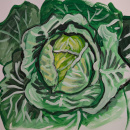
Dana’s eyes began to see nothing but green, all that spectacular green, a breathing, growing biome that the crew had unfurled throughout their small, space-faring shell. The green of sprouting chickpeas, cabbage, broccoli, garlic, onions, carrots, spinach, kale, green everywhere. More than anything, Dana wanted her paints. She would need so many to fairly render this subject, her Cobalt Turquoise, her Sap Green, the Hookers Green and yellows and browns and more besides. She wanted her brushes, her good paper. There was just so much to do.
____________
New Jersey native D. M. Riemer is a relative newcomer to fiction, but has a long history with screenwriting. He has authored five feature screenplays and 25 short scripts, several of which have been produced. He now divides his time between writing and photography. You can find examples of both at donriemer.com.