 Drawing the Line with AI
Sometimes I see amazing scenes in my dreams. No doubt some future invention will be able to discern the patterns of those dream images in my brain and print them out. Years ago, I would whip out my easel and oil paints when I awoke, and try to capture the image on canvas.
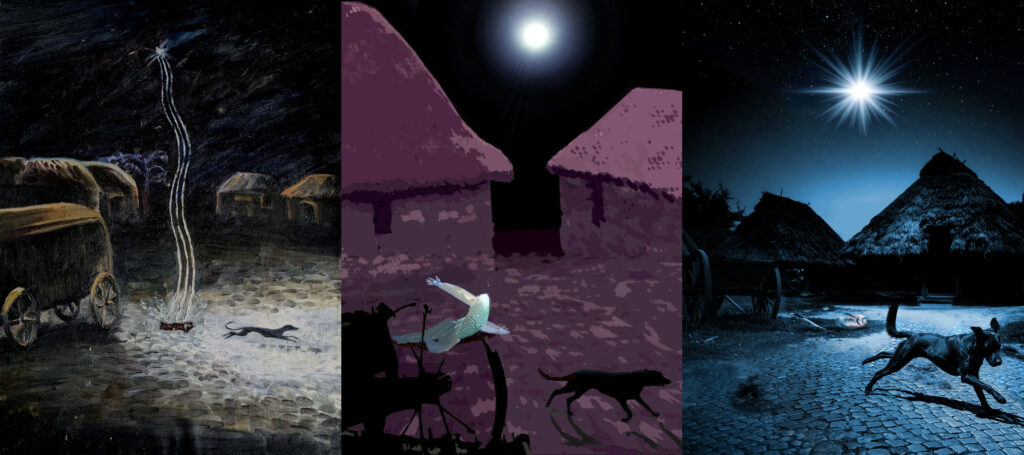
The left side of the triptych above shows one of those paintings, probably done in 1971. The central panel is a reworking of the dream idea from around 2013. To create it, I took my photographs of a wheel, a dog, a human model, and a fish and combined them with a photo of an indigenous village my grandmother had taken on a South American vacation. I used Gimp filters to meld everything and to create the star. The left panel I created this week, using Adobe Firefly. I generated a bunch of images with a prompt describing the scene, then chose a half dozen that got some element of the scene right and combined them, along with a couple additional images depicting details of the scene, adjusting the color, scale, rotation and boundaries of the various elements in Gimp until I had a whole that expressed the message of the dream.
I don’t feel that it was wrong to make the Firefly image. Adobe advertises that they use only non-copyrighted material to train their AI, so I’m confident that no artists were robbed for my creation (all Abyss & Apex story illustrations will be done with Firefly from now on, unless the author requests a non-AI illustration).
Is the third panel of the triptych less a piece of art because it used generative AI? True, I did not create any of the elements that combined to form it, but I didn’t create the elements of the second panel, either—they were photographs. Only the first panel is truly an original piece of art in that sense. Of course, I didn’t mix my own oil paints, as a Renaissance artist would have; they were store-bought. But I don’t see any of the panels as a copy of previously created artwork. Each depicts the dream scene as nearly as I can get it (until the brain-pattern printer comes along).
But even though I have embraced AI as an artistic tool, there are some things I draw the line at. I’ve never used ChatGPT. I program without AI assistance and my website was created with HTML and CSS. Turning to chatbots for human connections is, in my opinion, like relying on a Magic 8 Ball for guidance.
The real danger, as I see it, is letting AI take care of everything, as our devices seem to be urging us. Then no one will need to write, think, or communicate with another person—AI will do it all for them. My son, who teaches computer science, tells me some students try to get AI to do their assignments, but AI coding is flawed. It’s only useful if you already know how to code. The same holds true for art. AI is a wonderful tool when used for specific projects, but we humans still need to master the basic skills on our own.