 Drawing the Line with AI
Sometimes I see amazing scenes in my dreams. No doubt some future invention will be able to discern the patterns of those dream images in my brain and print them out. Years ago, I would whip out my easel and oil paints when I awoke, and try to capture the image on canvas.
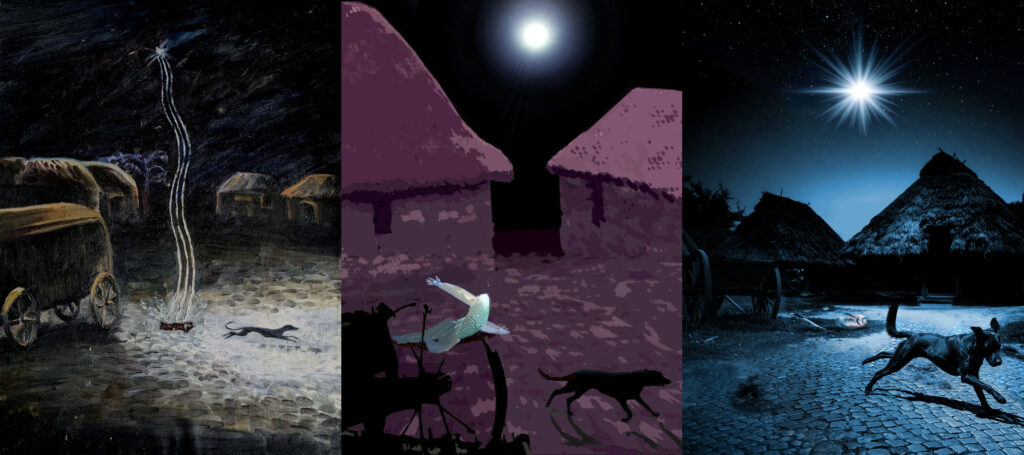
The left side of the triptych above shows one of those paintings, probably done in 1971. The central panel is a reworking of the dream idea from around 2013. To create it, I took my photographs of a wheel, a dog, a human model, and a fish and combined them with a photo of an indigenous village my grandmother had taken on a South American vacation. I used Gimp filters to meld everything and to create the star. The left panel I created this week, using Adobe Firefly. I generated a bunch of images with a prompt describing the scene, then chose a half dozen that got some element of the scene right and combined them, along with a couple additional images depicting details of the scene, adjusting the color, scale, rotation and boundaries of the various elements in Gimp until I had a whole that expressed the message of the dream.
I don’t feel that it was wrong to make the Firefly image. Adobe advertises that they use only non-copyrighted material to train their AI, so I’m confident that no artists were robbed for my creation (all Abyss & Apex story illustrations will be done with Firefly from now on, unless the author requests a non-AI illustration).
Is the third panel of the triptych less a piece of art because it used generative AI? True, I did not create any of the elements that combined to form it, but I didn’t create the elements of the second panel, either—they were photographs. Only the first panel is truly an original piece of art in that sense. Of course, I didn’t mix my own oil paints, as a Renaissance artist would have; they were store-bought. But I don’t see any of the panels as a copy of previously created artwork. Each depicts the dream scene as nearly as I can get it (until the brain-pattern printer comes along).
But even though I have embraced AI as an artistic tool, there are some things I draw the line at. I’ve never used ChatGPT. I program without AI assistance and my website was created with HTML and CSS. Turning to chatbots for human connections is, in my opinion, like relying on a Magic 8 Ball for guidance.
The real danger, as I see it, is letting AI take care of everything, as our devices seem to be urging us. Then no one will need to write, think, or communicate with another person—AI will do it all for them. My son, who teaches computer science, tells me some students try to get AI to do their assignments, but AI coding is flawed. It’s only useful if you already know how to code. The same holds true for art. AI is a wonderful tool when used for specific projects, but we humans still need to master the basic skills on our own.
I have been struggling with the ethical implications of this debate ever since MidJourney and ChatGPT began generating images.
Since 2016, I have employed CG artists — including some Blender developers — to create 3D characters the old-fashioned way through concept art, modeling, rigging, texturing, lighting, and rendering, the same kind of workflow film studios have used for decades. As a compositing, lighting, rendering, and pose artist, I can now assemble scenes that rival what Disney or Pixar could create visually. My goal is to produce static illustrations for my new novel using a workflow that professional studios have relied on for years.
But Ms. Brunish is correct about one thing: you cannot simply let AI generate everything and call it your own. Frankly, it is not even particularly good at doing that. Left unchecked, it produces what many people now call “AI slop.” You still have to write the narrative. You still have to art direct the visuals. You still have to curate, revise, reject, refine, and shape the final result.
The difference is that AI functions as a kind of super-assistant. It can rapidly propose alternatives, revisions, refinements, and technical solutions, but the human creator still has to exercise judgment and control. Sometimes — just like human collaborators — AI never gets it exactly right.
The difference is cost.
As the director or employer, I can iterate endlessly without being viewed as “difficult” or worrying about hourly billing for every revision. Stanley Kubrick famously demanded enormous numbers of takes from actors in pursuit of perfection — but he had massive budgets to support that process. Most indie creators do not.
I could have hired a traditional illustrator to painstakingly draw or paint the 30–40 illustrations I need for my novel. The problem is that I cannot draw or paint myself, and the number of back-and-forth revision cycles required to communicate the exact images I see in my head would be overwhelming. At some point, I feel I would lose creative control over my own vision.
Now my team is watching something new emerge.
Image and video AI systems can already generate imagery from prompts, reference images, or “art direction by example.” In some cases, these systems can now perform half — or even most — of the technical production work I currently do manually.
Even the professional CG artist I work with sees this shift coming. After twenty years in the industry, he has begun learning tools like ComfyUI, FLUX, LTX, and Google Nano Banana because he understands that the field is changing. He is experimenting, adapting, researching, and trying to figure out where he fits in this next wave.
I begin the illustration phase of my project in September. Right now, I still have artists building custom digital wardrobes, hair grooms, and environments for me. But I would be lying if I said I was not worried that some of this work could soon become financially obsolete.
My message is this:
For the “little guy” — the indie author, indie publisher, or solo illustrator trying to compete with major studios and publishing houses — do not dismiss AI too quickly.
I cannot afford a traditional production studio. Most indie creators cannot.
So what exactly are people like me supposed to do? Abandon our stories and ideas because traditional production pipelines are financially out of reach?
Like every production company or publisher facing economic pressure, I am looking for ways to reduce costs while still reaching readers with the stories I want to tell.
If artists are offended by that reality, then the industry also has to acknowledge the economic side of the conversation. Many independent creators cannot afford premium rates, endless revision fees, or large production teams.
AI is not eliminating the need for artists. It is changing the economics of how creative work gets produced.
And for many indie creators, that change may be the only reason some projects ever become possible at all.