
Fighting Shadows
From their earliest times, stories have dealt with human fears and invoked protagonists wielding the latest in wisdom and technology to prevail against them.
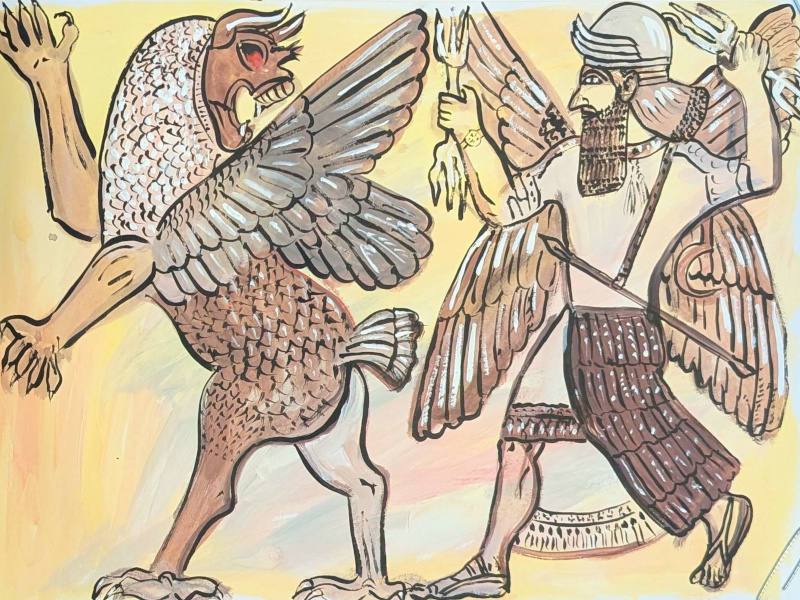
For instance, the third millennium BC Mesopotamian tale Lugal-e, or Ninurta’s Exploits, tells of the god Ninurta’s triumph over Asag, the monster of disorder and chaos. Asag has convinced various stones to stop performing their allotted tasks and to help it wreak destruction upon humanity. When Ninurta responds to people’s cries for help, Asag uproots the sky and unleashes a dust storm, drying up mountain waters. Ninurta is aided by a rainstorm that allows him to restore the river Tigris. He uses the excess waters for irrigation. After Asag has been thoroughly undone, Ninurta deals with the rocks of its former army, assigning each mineral its role in life according to how rebellious it had been. The emery stone will wear itself out as a grindstone, while diorite will be used to make the statues of kings and be much admired.
At the time of this story, irrigation and stonework were civilization’s greatest achievements. Also, at this time, astrology and astronomy were one and the same. Mesopotamian astrologers carefully tracked the movements of moon, sun, stars and planets, believing the pattern of celestial objects were messages written in the sky by the gods.
Thousands of years later, at the turn of the twentieth century, the gods were no longer with us. Reliance on astrology as a window to the future had given way to trust that new scientific discoveries would enable our species to master the universe.
In Jules Verne’s novels Robur the Conqueror (1886) and Master of the World (1904) a marvelous machine that can travel beneath and on the sea as well as on land and in the air drives the story. H.G. Wells conquered time in The Time Machine (1897). In The Life Everlasting (1911) Marie Corelli posited that electricity had answers for all of humanity’s questions.
But invasion literature also became popular at this time, inspired by the global situation that was leading toward World War I. H. G. Wells’ War of the Worlds (1897) describes Martian invaders, while William Le Queux churned out novels in which France and Russia or Germany invaded England.
After World War II, the shadow of nuclear war and the possibility of humanity’s utter annihilation by war or some other disaster made itself felt in apocalyptic novels like Nevil Shute’s On the Beach (1957), John Wyndham’s The Day of the Triffids (1951), and Piers Anthony’s Rings of Ice (1974).
Apocalyptic stories remain popular. I see many among Abyss&Apex submissions, especially environmental disaster stories. The most recent variation on the theme is, of course, AI disaster stories, in which humanity’s own creation robs its makers of life force and self-determination. AI is a new invention, but I think the concept of extinction following total dependence on helpful devices goes back as far as E.M. Forster’s The Machine Stops (1909). Or perhaps to H. C. Andersen’s The Nightingale (1843).
Humanity’s suffocation in AI’s all-helpful, cloying grasp feels like a possible future. But I prefer to focus on more positive alternatives in which someone like Ninurta comes along to conquer the out-of-control tool and put it back in its place.