
 Where They Were at the End
by James Van Pelt
Dennis paced the bunker. “I’m just saying they’re commie gods: Krushchev cronies. The Ruskies orchestrated Cuba’s disappearance and blamed us. Do you think a weakling like Kennedy would vanish an entire island country? Nope, not a chance. Khrushchev shipped missiles. We say no way. The world knows we’re the good guys. We’re defending ourselves! Then Cuba, poof, gone. Leaves a hole in the ocean. Tsunami wipes out Cancun, Panama City, Caracas, while the Russians blame us. Say we destroyed their Communist ally so they couldn’t set up missiles. It’s a fake out. They’ve got some Lenin Marxists gods on their side. Bombs or gods, you use the weapons you have.”
Mrs. Larson wore a blue patterned summer dress with two-inch heels, which is what she’d chosen to address the DAR as the chapter vice regent, a position she’d held since she turned forty, two years ago. The civil defense warning alert came as she pulled her car into the driveway.
“Not sure I buy that. You sound like an acolyte.” She sat on the lower bunk, ankles crossed, leaning against the bomb shelter’s cement wall. “Miami, Tampa, New Orleans and Houston drowned too. You think the world believes we’d sacrifice ourselves to frame the Russians? Pretty wild idea.”
Dennis had been mowing his lawn. Grass-stained work shoes, worn jeans and a short-sleeved shirt. They graduated high school together, but they didn’t know each other then. When he moved in they joked about having bought neighboring homes.
Mrs. Larson said, “They’re clever, I’ll give them that. Frank served in Korea, and he told me Chinese commies were sneaky. Learned it from Russia. You can bet the Kremlin claims we pointed an elder god at Cuba or maybe an old one—I don’t know the difference—but gods are hard to control. They’re blunt instruments. We sank ourselves with overkill, the commies say, and in the meantime they benefit by destroying the southern coast of the good ole U.S.A. Two birds with one stone.”
“But where’d they come from, these gods?”
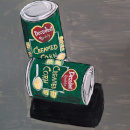
“Nuclear testing. We attracted them.” Mrs. Larson pulled a can off the wooden shelves that made up one side of the shelter. “Creamed corn. I hate creamed corn. I’ll bet Frank bought these on sale. I told him canned peaches would be good. Something you don’t need to heat.”
“CBS said a Necronomicon cult evoked them, and the Pope said it’s a sign of the second coming. I read the Senate’s investigating committee report. It didn’t talk about nuclear testing. They called it ‘anomalous intrusions of extradimensional entities.’ I don’t think whatever they are that they’re on anyone’s side. The committee said, ‘The entities ignore all attempts at communication.’”
Mrs. Larson snorted. “My word, they said ‘anomalous”? A week after a hydrogen bomb test and a mountain in Turkey turns into a mass of tentacles? A Russian hydrogen bomb, by the way.”
Dennis waved his hand at the crowded shelves. “Is it all creamed corn? You bought three months’ worth of creamed corn and nothing else?”
“That and a case of Spam. Creamed corn was on sale. We never thought we’d have to actually live down here.”
“We’d know more if the radio picked up anything.” Dennis turned the volume on the receiver by the bunker’s metal door shaped like a submarine hatch. Static hissed evenly as he twisted a dial searching for a signal.
“It’s broken.”
“Yeah, or there aren’t any stations left. It worked fine an hour ago. Emergency signals. Recorded evacuation directions, and that idiot who kept screaming, ‘He waits dreaming! He waits dreaming!’ Nothing now.”
“You’re a pessimist,” said Mrs. Larson. “And you’re driving me nuts. I shouldn’t have let you in. Frank wouldn’t have. He told me the neighbors would remember we’d built the shelter in the back yard. ‘We’ll be beating them off with stick when the shit hits the fan,’ he said. Serves me right, being soft-hearted.”
Dennis shrugged. “Frank and I got along. We cohosted the barbeque last year. The man knows how to grill a steak.” He returned to the bunk. “Water, creamed corn, spam and a radio. This seems under planned.”
Mrs. Larson opened a low chest by the canned goods. “Also a change of clothes, a go bag with I don’t know what all survival goods in it, a pistol, ammo, and a Geiger counter. The other chest has coats and blankets. I’d say we’re set. We wait for the fallout to settle, or for them to call the gods off. We’re in here a week at most.”
“Can you call gods off?”
The ground rumbled, shaking dust from the arched ceiling.
Dennis said, “There it goes. You think that’s Phoenix?”
Mrs. Larson shook her head. “Don’t know. Might be Flagstaff. We have National Guard bases in both. Luke Air Force Base near Phoenix is huge. Seventy miles from us either way.”
“Where’s Frank?”
“Flagstaff.”
“I’m sorry to hear that. I’m sure he’s okay. Maybe it’s not gods or bombs. Whole thing’s a false alarm. It could be an earthquake.”
“Possible,” said Mrs. Larson. “We had a pretty good one last year, but that would be coincidental, don’t you think, that we head to the shelter and the ground starts trembling?”
Dennis looked at his feet, as if he expected the earth to move. “I don’t know what a distant nuclear explosion would feel like. I’m also not sure how I’d know a god was about. What does your Geiger counter say?”
Mrs. Larson took a loaf-of-bread sized yellow metal box with a handle from the chest. “Nothing. No radiation, but we’re miles from anything worth bombing. Even if we were downwind, it wouldn’t have reached us yet.”
The ventilation system kicked on, pulling air out of the bunker from one vent and blowing air in through another. “There’s filters too,” she said.
“Gods aren’t radioactive. How can you filter god air?”
The ground shook harder. The lights flickered, and a can fell over.
Dennis said, “That’s closer. Can you check the periscope? See what’s going on?”
“We’ll get a view of my geraniums and fence. We’re safe. If anything happens, we have ten feet of dirt and two feet of reinforced concrete above us. Besides, America is a super power.” She stepped to the periscope pole, cranked it up, resting her hands on the turn bar as she rotated, her face pressed to the eyepiece.
She stopped, backtracked, then went around slowly.
“What do you see?”
“It’s 3:00 or so, right? Sunny when we came in?”
Dennis checked his watch. He grunted. “Yes, no clouds.”
She stepped away, a quiver in her voice. “I’m not sure what I’m seeing. Check it out.”
Dennis stayed at the periscope, looking one direction for a while before turning and pausing again.
“Where’s the fence? Where are the houses?”
“The periscope must be broken. Crummy lenses,” said Mrs. Larson. “I told Frank when he built this that he shouldn’t buy military surplus.”
“The sky’s purple, or . . . I don’t know what that color is. No sunlight. It’s not natural. It’s like the sky has veins.” He turned half way. “Pulsing veins. It gives me a headache.”
“Nothing can happen here. We’re not strategic. Dead center Arizona is safe. That’s why we moved here. That’s why we built a bomb shelter while everyone else ignored the threat. The whole world could go to hell and Frank and I would survive. If we open the door and walk up the stairs, it’s a pleasant afternoon in my backyard. America has the strongest military in the world. We have the strongest gods. We have right on our side.”
“I don’t think the periscope is broken.”
Mrs. Larson said, her voice rising, “It’s the fog of war then. A god weapon, that’s what it is. It’s a good-old U.S.A. god giving us cover. The commies are on the run.”
“That’s not what ‘fog of war’ means.” Dennis straightened. “Did the floor tilt? Did you feel that?”
“If you get hysterical, you just make the situation worse.”
“You’re hysterical.”
The bunker lurched, canted away from the shelves. Dennis put out an arm to brace himself against the wall. Mrs. Larson leaned.
Another thump jarred the shelter. Then another, and another. Cans jumped off the shelves, clattered to the floor, rolling toward Mrs. Larson.
“It’s heading our way,” Dennis said, on the edge of a scream.
“I don’t think they’re on our side,” yelled Mrs. Larson.
Both ceiling vents sucked air, but the fans weren’t turning. Their ears popped as the pressure changed.
Mrs. Larson grabbed the periscope again, hung on, looked outside. Didn’t speak.
“What is it?” Dennis gasped. “Are they Americans?”
“Everything’s coming apart. The land . . . I see . . .” She wheezed, fought to take a breath. The light winked out.
“The stars,” she said in the dark. “The stars. They’re hideous.”
_______________
James Van Pelt has been selling short fiction to many of the major venues since 1989. Recently he retired from teaching high school English after thirty-seven years in the classroom. He has been a finalist for the Nebula, the Theodore Sturgeon Memorial Award, Locus Awards, and Analog and Asimov’s reader’s choice awards. Years and years ago he was a finalist for the John W. Campbell Award for Best New Writer. He still feels “new.” Fairwood Press recently released a huge, limited-edition, signed and numbered collection of his work, THE BEST OF JAMES VAN PELT. He can be found online at https://www.jamesvanpelt.