
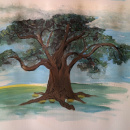
 Cloud Breaker
by David McGillveray
Enlightenment came to Naizan in a black staff car and two trucks full of soldiers. Anyela watched them pull into the central circle of the village from where she lay on the lowest branch of the tree, the vehicles throwing up a cloud of dust. The sounds of engines and shouting drifted upwards.
“So noisy, Oda,” Anyela whispered to the imp beside her, who sat dangling its legs over the edge of the platform. It looked up at her with green, expressive eyes set between a pair of leafy ears. She took its hand in hers, reassured by the tiny, hard palm.
Two officers had stepped from the car and were standing somewhat uncertainly in the village circle while the soldiers fanned out around them. All was silent. At length, the shorter one cupped his hands to his mouth and shouted in accented Tinween, “Show yourselves for the forces of the Grand Western Enlightenment!”
Anyela watched as Pada Sassos, who had clearly been watching, probably along with everyone else in the village, emerged almost immediately from the Thanking House and came to meet them. His much-patched green robe contrasted with the smart Enlightenment uniforms. Words were exchanged and arms were waved about. Voices were raised, and then Pada Sassos led the men unenthusiastically towards Naizan’s only hostelry, closed since the war.
“I have to go to mum and Mahron,” Anyela said. She stood up and dusted down the back of her canvas trousers.
The tendril that attached the imp to the tree snaked from the back of its neck and was reabsorbed before it too climbed to its feet. Anyela knelt before it and kissed it on its woody forehead.
“I’ll be back soon, Oda, I promise. Bye bye.”
The little creature nodded then scampered along the branch and vanished into the foliage.
Anyela worried about her mother. Her father had been called up, and like so many others had been swallowed up in the chaos of fighting along the coast. They’d heard nothing of him, cut off here since the victorious Westerners had prohibited travel. The Tinween radio stations had stopped broadcasting news, replaced by propaganda and martial music. Mother had not been herself since. Anyela had pursued a solitary childhood, spending much of her time exploring the tree rather than with her peers, but at fifteen was beginning to recognise her responsibilities.
She ran down the staircase that spiralled around the trunk, skirting the village and its unwelcome visitors as she made her way home.

“Fine country,” Alvers said, earlier that day.
He had taken off his cap and the wind blew in his hair as the open staff car and its escort drove through the countryside inland from Tinwa City. The land rolled away around them, meadows and cultivated fields criss-crossed by streams and dirt tracks and patched with small copses of trees. The air was fresh, the sky clear and he found the gentle undulations of the landscape pleasing, like a green ocean frozen in place.
Alvers’ companion was scribbling notes in the margins of a book. Now he looked out of the car for perhaps the first time. “It’s ours now,” he said. They passed a solitary farmhouse set back from this, the only paved road into the interior. Four young kids in shorts and little else playing in the front yard stopped their game to stare as the small convoy passed. A thin woman, their mother, stood in the doorway. “The natives spoil it, though.” He returned to his book.
Alvers sighed. Much as he had tried, he had found that Captain Cavorian, his section’s mandatory political officer, was not much of a conversationalist. He looked at the map spread out in his lap. It was a local Tinween printing and he struggled with some of the markings. He squinted at the unfamiliar place names and ran his finger over the line of the road before leaning forward and speaking to the driver.
“The turning’s about three quarters of a mile on the right. There don’t seem to be any other roads on that side before that.”
The driver nodded.
They turned on to a narrow dirt track a few minutes later. The route was punctuated by low stone bridges and occasional passing points for traffic coming the other way, of which there was none. The trucks behind them coughed smoke and crunched their gears on the rough road. Alvers was amused to see his colleague’s pencil slip and scrawl a long line across the page he was reading as the car bounced into a rut.
“Bumpy,” he smiled.
Irritated, the other man set his book aside and snapped, “You may be an admirer of the country, Major, but I have already seen a number of ways we can improve it.”
“Really? You’ve had your nose in that book for the last hour. I’m surprised you’ve noticed anything.”
Cavorian glared at him. “The Book of Defined Ways brings its adherents many insights. If you spent more time between its pages rather than gawping at greenery, you might make a better servant of the Enlightenment.”
“I’ll try and remember that,” Alvers said. They continued in silence a while, the track now following the banks of a river. Lilies floated on its surface and trees grew in close on the other side, bringing the moist scents of the forest. The car turned away from the water and began to climb the side of a valley.
“It’s ironic, isn’t it?”
It was Cavorian’s turn to sigh. “What is?”
“That for a society like ours, progressed beyond the need for religious faith, that the greatest guardians of our Enlightenment spend so much time with the good book. I mean, you treat it like a bible.” Alvers couldn’t help needling Cavorian. It was fine sport, and he felt his successes during the invasion afforded him some protection.
“I know you’re trying to provoke me, Major, so I won’t bite this time,” Cavorian said. He leaned towards Alvers. “But I do bite. Attitudes contra to guidance must not be allowed to persist.”
“Is that a quote?” He knew that it was.
“The Defined Ways have brought us this far, haven’t they? They’ve raised us above all the others of the world and brought us across the ocean triumphant. You should recognise that.”
Their procession breasted the top of the valley, and Alvers suddenly stood up in his seat, dissipating the tension between them. He shaded his eyes with a hand and peered ahead. “Is that it?” he breathed. “Incredible! It must be miles away still and look at the size of it!”
In the haze of distance, something vast reared from the earth, taller by far than anything even the Enlightenment had raised up in their cities across the sea. An enormous tree, godlike in its proportions surrounded by a halo of birds. In Tinween it was called a cloud breaker.
“My God,” said Alvers.
Cavorian frowned.
They knew nothing, these foreigners. Earlier in the morning Anyela had watched in horror as a group of soldiers cut down a series of sibling trees near the river with some sort of mechanical saw. Now they were building a stockade around the Thanking House.
To add to this inexplicable behaviour, the officers had decided to make the journey of four hundred yards to Anyela’s home in their car. She watched as the driver climbed out of the front seat and opened the doors for the two senior men. Everyone wore guns.
“I’ve never seen a car that big before,” whispered Mahron admiringly. The vehicle’s surfaces were polished black and silver, with large round headlamps and maroon leather seats. On the prow of a long bonnet the silver hawk of the Enlightenment spread its wings. The three of them stood on the porch as the officers straightened their uniforms and came towards them.
“A beautiful morning,” the taller one said in passable Tinween. He was handsome in a worn sort of way, with a wide face and revealed honey-coloured hair as he removed his hat. He was maybe late thirties, although it was difficult to guess with these Westerners. “I’m Major Stam Alvers and this is Captain Bengt Cavorian of the occupying forces, as I’m sure you have understood.”
“Hello,” Anyela’s mother replied. “What is it you want?” She worked hard to keep her voice steady but Anyela could feel the quiver in her body; no one knew what to expect from these people.
She examined the two men. Both had pale, almost colourless eyes. It was amazing to see such different things when she looked into such similar eyes. With Alvers there seemed to be something human in there, some hint of warmth deep down. The other one, though; here was something cold and hard, something coiled and dangerous. His eyes raked her body as he stood there silently holding his black book.
Alvers looked in a notebook taken from the inside pocket of his jacket. “According to the census in Tinwa City, you are Mada Aisha Kastifar, yes? Husband to Hilal Kastifar, mother to Mahron and –”
“Have you seen him?” Aisha interrupted. “Do you know where he is?”
Alvers looked a bit surprised to be put off his stride, but he recovered quickly. “Your husband? I’m afraid not, Mada. Things in the cities are still somewhat disorganised. He could be in a detention centre if he was involved in the fighting. If so, your best hope is he’ll be processed, and one way or another in time you’ll find out what happened to him.”
He cleared his throat and consulted his notes again. “That’s a strong looking young lad you’ve got there.” He attempted to smile at Mahron but couldn’t quite make it work. “Mada, it’s my duty to inform you that by order of the Enlightenment all males between the ages of twelve and eighteen are to be requisitioned for work duty in the rebuilding of the nation. Your son is required to come with us.”
Mahron was thirteen. “Mum?” he said. He grabbed her arm and hung behind her like a child much younger.
“No! You can’t take him!” Aisha cried, unbelieving, her voice rising. “I’ve already lost a husband.”
“I’m sorry, Mada,” Alvers said. “I know this is hard, but it’s for the good of his country. We’ll hold him here for a few days, you’ll be able to see him before he goes.”
“No!” Aisha screamed. She was crying now. “No, what is this now?”
Anyela tightened her grip on her mother’s shaking shoulders. Angry, she demanded, “Where are you taking him?”
Alvers waved towards the Thanking House. “We’ve using that big building over there. Transport will be arranged to take the young men where they’re needed by the end of the week. In the meantime –” He shrugged. “Well, they’re a flight risk, aren’t they? We can’t have them disappearing up that big damn tree of yours.”
The other man, Cavorian, stepped forward for the first time. He rested his hand on his sidearm. “Hand him over. Now.” Anyela thought his voice was like his eyes.
Cavorian dragged Mahron from his mother’s grasp. He didn’t resist, just stumbled as he was pulled forward, looking backward askance at his family. Cavorian handed him into the care of the driver.
“What’s in there?” he asked, pointing to the barn by the side of the house as if nothing had happened.
Aisha was distraught. Anyela answered. “Farm equipment. This is a farm.”
Cavorian strutted over and looked inside. “There’s a tractor in here,” he called back. When he returned to the others he said, “That will also be requisitioned, along with a number of other items that could be used for offensive purposes.”
It was the only tractor in Naizan. Father had been so proud of it, helping people when they needed a boulder dragged from a field or a cow pulled from the river. Last year, he had taught Anyela to drive it. He had sat next to her on the big seat that sat so high above the ground.
It was this memory that made the tears come as they took Mahron away, the two women clinging to one another in front of the empty house.
Four hundred and eighty-four paces!
Alvers circumnavigated the trunk of the cloud breaker, climbing over and under roots the size of train carriages. There were fallen leaves like enormous umbrellas, piles of them where you could go in up to your neck if you weren’t careful. The air smelled of the earth, rang with birdsong. How deep did those roots sink? To the bedrock, certainly. To the centre of the earth! Why not?
The tree’s bark was an opulent dark brown, like the best chocolate, inscribed with whorls and ridges like some hidden language. Above his head, the trunk reached up and up to disappear into the thinning air, breaking the clouds. Alvers placed both hands against the bark and imagined he could feel the great life within, slow and patient, almost immortal, transmitting its inscrutable messages through the skin of his palms.
It was good to be alone for a time, away from the men and the consequences of following orders that had cast him as some sort of latter day tyrant. Naizan’s boys had been locked up in what they called the Thanking House for two days now, and Alvers could feel the upset this had caused hanging like a pall in the air over the place. It was true about the need for labour, but the leadership were really concerned about the formation of partisan groups, and teenage boys were angry by nature. Mind you, so were their mothers. The women of the village knew how to put venom into their glares, no doubt about that.
It had pleased that pig Cavorian no end to take their church away from them. It fitted neatly into the worldview he had been given by the Book of Defined Ways so he didn’t have to think for himself. Ironic then, one quasi-religion pushing on another, neither admitting to the worship of gods. The priest or whatever he was, Pada Sassos, had been outraged with the commandeering of the Thanking House and made all manner of dire warnings about the retribution that would fall down upon them. Living in a place like this, what else could the people do but worship their tree? Alvers could understand it. Four hundred and eighty-four paces around! If that wasn’t a divine circumference, he didn’t know what was.
He had returned to the curious staircase he had noticed when he first approached the tree. Examining it again, he noted how the steps seemed so like a part of the trunk, their contours rounded and as uneven as nature, formed from nubs and protrusions and natural hollows in the wood. He supposed this was the result of generations of footsteps wearing it away on their way to whatever strange rituals went on up there in the branches. It looked precarious enough, mind, little more than the width of his shoulders and with nothing to separate those ascending from empty air.
Keeping his left hand against the trunk, Alvers started upwards, placing one foot carefully after another. He began to feel increasingly uncomfortable as he spiralled round the body of the tree, the distance to the ground increased, butterflies fluttering in his stomach and the breath catching in his throat. Strange, he had never been especially worried by heights.
He paused and breathed deeply for a minute, trying to get a grip on himself. With an effort he continued on until he stepped with relief on to the broad back of the lowermost branch. He sank gratefully on to a natural platform some thirty feet out from the trunk until his nerves returned to something approaching normal.
Maybe the stress of the last month was catching up with him. The command had planned endlessly for the invasion of Tinwa and the long steam across the Middle Ocean had been an exercise in patience and discomfort. The brief period of fighting had almost been a relief. The Enlightenment fleet had descended on the strategic points along the coast and either taken the towns without a fight or bombarded them into submission in a matter of days. The Tinween had not been prepared for war, and the Enlightenment had hardened its resolve and advanced its technology in the long years of the Unification Wars on their own continent.
Alvers had benefited from the military life since he’d joined up as a boy. It had given him purpose and stability and certainty, and on a visceral level he loved the enhanced emotions of battle; the danger and the fear and the jubilation. The invasion itself had had its brief moments, but subduing little villages like Naizan and taking their children did not fit in with his self-image as a soldier. As he’d gotten older, Alvers had noticed within himself an annoying tendency to think.
From where he sat he could look out over Naizan and the countryside beyond all the way to the Eastern mountains lost in the blue haze of distance. There were other cloud breakers out there, he knew, although very few, sparsely spread, each the centre of its own sphere of influence. They were watered by the rivers that flowed down from the mountains, fed by the great fertile plain of inner Tinwa that the Enlightenment had so coveted from afar.
Naizan itself was part-bounded by a river, the Louma according to his map, that bent around the little town like the cradling arm of a mother. Beyond the margins of the village were cultivated fields, although he noticed that many had been left untended despite this being peak summer growing season. He had seen the same several times on his journey from the coast, and it was storing up a problem for the year’s winter. Most of the farmers who had previously worked the land were dead or in labour camps.
This, the lowest branch of the tree, reached out some fifty yards above the ground. The whole village stood in shadow half the day, but it was somehow a benign shadow, broken up by the warm sunlight that shone through the tree’s foliage. Alvers could see his staff car parked beside the inn that they were using as a billet on one side of the circular area that was Naizan’s focal point. It stood near the Thanking House with its new stockade where they were holding the boys before they were taken for processing.
From here, he could see little houses nestling between the humps made by underground roots, circular or lozenge shapes, nut brown in colour. The cottages towards the central circle were arranged a bit more regularly, but still had the look of things that had grown from the earth rather than been built using saws and hammers. Little stands of trees like miniature versions of their giant parent followed the natural lines of the land or the path of the river. Everything was silent at this moment, apart from birdsong and the flutter of leaves in a gentle breeze.
He breathed in. Everything calm. Everything bound together. Nature, arranged.
He gazed out over Naizan again, grappling with a new understanding.
He turned abruptly at a sound behind him, hand automatically reaching for his pistol. The life of the tree grew thick above him, a mass of green many times greater than any giant beast of the ocean, huge leaves that could enfold a man, branches that had grown strong before any civilisation had quickened on the earth. He felt the same pressure he had felt as he climbed the staircase begin to grow in him again, an unsettled feeling in his gut, his chest tight. The skin on his forearms rose in goose flesh.
“Who’s there?”
The noise came again, a gentle rustling as something moved somewhere above. For a split second he looked into a pair of luminescent green eyes before they were gone. He stood there, trying to find whatever it was again but it had disappeared into the vast vertical countryside of the cloud breaker. Nevertheless, he felt watched. The feeling persisted until his feet were back on the ground.
“We have to do something.”
“Yes,” agreed Pada Sassos.
“They’ve turned the Thanking House into a prison!”
“I know.”
“I’m not losing my brother.”
“No.”
“Or any of the others.”
“No.”
“So will you speak for the village?”
“I already have.”
“Right. Good! So what’s the plan?”
“I don’t know.”
“What?”
“We need to make one, with the seniors.”
“There’s no time for that. We need to do something now before the boys are moved.”
“But—”
“I’m going to talk to Oda.”
Anyela ran into the deepest shadows of the tree. Oda was sitting on a large root near the bottom of the staircase trimming its toe claws with its teeth.
“That’s disgusting,” Anyela said quietly, settling down beside it. “You think I can’t see what you’re doing in the dark? Are you ready?”
The imp removed a foot from its mouth with dignity. It nodded once, a jerky copy of a human gesture.
She was nervous. She had told Aisha nothing, did not want to pile any more worry on her. But Anyela wouldn’t let them take Mahron away. She wanted to fight like her father.
The sound of heavy footsteps approached, and muttered complaining as a toe was stubbed.
“You are like a ghost,” Anyela whispered as Pada Sassos moved up beside them. He was breathing hard.
“I can’t believe you talked me into this,” he snapped. “I’m an old man.”
“Only when it suits you, Pada.”
“Hmmf. There are two soldiers outside the stockade, but there are others awake at the inn,” Pada Sassos told her. “We’ll need to be quiet.”
“Does that rule you out?” Anyela asked.
“I remember when you were a less insolent girl, but it was a long time ago,” he replied. “No, I’ll do my part first. Oda here will help me, won’t you?”
The imp, of course, said nothing. Instead, Pada Sassos turned his back and the little creature climbed up his legs and wrapped its arms round the old man’s neck, clinging there like a child in fancy dress ready for the Solstice Festival. “Stay out of sight, and get ready to run if anything goes wrong.”
Anyela didn’t argue. They had already talked this through.
Pada Sassos headed off into the village with Oda on his back, threading his way through the sleeping homes. Anyela followed at a distance. Sneaking around in the dark was something she had done many times before when she had wanted to be alone, but in all those times there had never been any real danger. Being told off by an adult for sneaking up the tree at night was very different from being shot by an Enlightenment guard.
Pada Sassos approached the stockade around the Thanking House. The wood the soldiers had taken to build it was dead now, taken without permission. This was a double injury, for the Thanking House was the heart of Naizan. To misuse it for something as utterly inappropriate as a jail was the thing that had really made Pada Sassos angry.
He made no effort to hide himself as he came out from between the houses on to the edge of the village circle. One of the guards at the gate immediately called for him to stand where he was and shone a flashlight in his face.
“Why are you out after curfew? Return home immediately.” The two guards came forwards and squinted at the old man. “Wait. What the hell are you carrying?” said one.
“Just my familiar. I’m a wizard, you know,” said Pada Sassos.
The other guard laughed but there wasn’t any humour in it. He gestured with his rifle. “What a load of bollocks. Get on your knees. Now.”
Pada Sassos gathered up his robes and sank slowly to his knees, wincing a little. Equally slowly, Oda climbed down from his shoulders and squatted on the ground, hands and feet pressed flat to the earth. The Enlightenment men didn’t know what to make of Oda. They stepped backwards and covered the imp uncertainly with their guns.
“What’s next?” Pada Sassos asked them. He covered his terror with a smile. These soldiers were young and in a strange situation. Death was only the twitch of a finger away. He could feel a vibration in the earth as Oda worked. “Do you feel it too, my magic?”
The guards looked at one another. “I’m going to call the sergeant,” said one.
A low rumbling sound preceded the opening up of the ground beneath their feet. A hole appeared, displaced soil falling into it and the two men were swallowed up without a sound. There was a sense of something huge moving beneath the earth.
Pada Sassos struggled to his feet. “Come on, Oda.” He picked up the imp and ran to the rear of the stockade out of sight of the inn.
Anyela was waiting with eyes wide open. “I’ve never seen anything like that before.”
“Well, watch again.”
Oda was already down on all fours beside them, pressing its hands against the ground before the wooden posts of the stockade. Anyela skipped away as she felt the ground give beneath her. It began to slump, dirt falling into a newly formed hollow, growing wider and deeper. Daring to peer down into the gap, Anyela felt rather than saw leviathan movement below ground, the shifting of immense roots in the soil. The portion of the fence nearest to them splintered and sagged. Oda stood up. All movement had ceased. Before them was now a gap they were able to clamber through.
Anyela listened for a moment but the night was quiet again. “Sounds like we’re still clear.” She climbed through the stockade and scuttled to the back of the Thanking House. When Oda and Pada Sassos joined her, she said, “The entrance faces the inn. It’s too risky to go round that way.”
The old man rested his hand on the curved wall of the building. It was smooth and textured like the skin of a chestnut. “Don’t forget this is the stuff of the tree. This part was arranged in advance.”
As Anyela watched, the wall of the Thanking House split open like the nut it resembled, almost silently, peeling apart to make an entrance ten feet high and three wide. She could see the living stuff revealed inside the walls, smell its pulpy greenness.
The boys, fourteen of them, had been sleeping on the benches inside wrapped in thin grey blankets the Enlightenment company had given them. They were sitting up at the disturbance, the darkness inside leavened only by a pair of tall candles set by the doors.
As she stepped inside the familiar space she wrinkled her nose “Ugh. Boy smell.” She found Mahron and ran to him. “Are you all right?”
“Yes, I’m fine. What are you doing here? What’s happening?” He swung his legs from the bench and shrugged the blanket off his shoulders. He was thinner maybe, but perhaps that was just her imagination. He wore the same clothes he had been taken in.
“Big sis is here to rescue you, what else?”
“Everybody up,” Pada Sassos said as loudly as he dared. He was looking around the Thanking House critically, looking for damage. He had spent much of his working life here, leading the thanks of the village to the one that gave them so much. He hoped he’d be back. “Everybody out.”
They went out through the strange incision in the wall, already closing, disappearing into the night, towards their cloud breaker.
Alvers wondered what had happened to Cavorian to make him like this, the fury waiting just beneath the surface, waiting for a reason to boil over.
“How dare they! This is an affront to us and the entire Enlightenment,” he screamed at Alvers. Both of them knew the men were listening in the room outside.
“Something will be done, Cavorian,” Alvers said, trying to bring the volume of their exchange down. “We’ll talk to a few of the women and find out what happened. We’ll get those lads back.”
“Not good enough! I will not have the authority of the Enlightenment undermined. I will not have our authority challenged. I will not have a blot on my record because of a bunch of simpletons living under a fucking tree.”
Now we get to it. Alvers sighed. “So what do you want me to do?”
“I don’t trust you to do anything.” Cavorian leaned over the table between them and levelled a shaking finger at the taller man. “You have been too easy on these people from the start, playing the reluctant conqueror. The decent man! It’s pathetic. I’m not surprised they think they can laugh at us. Well, they won’t laugh at me.”
Cavorian turned and pulled open the door of the small room that was the inn’s office and went out into the reception area. “You, you and you,” he shouted, pointing to three men he knew to be close to the Defined Ways. “Bring your weapons and follow me.”
The four men marched from the inn and into the village, which had been locked down since they had discovered what had happened at first light. Picking a house at random, Cavorian kicked in the door and sent two of the other men inside. They emerged a moment later dragging a woman by both arms, a squalling child little more than four years old running behind them. At the next house this action was repeated.
Cavorian had the two women dragged into the centre of the village circle, their children held back by one of the soldiers.
“I know you’re watching,” Cavorian shouted into Naizan’s silence. “You have until tomorrow morning to come to me and tell me where they are. Tomorrow morning! Or there will be untold grief in this place.”
Then he took out his sidearm and shot both of the women in the head.
“Leave them here as a reminder,” Cavorian told the others.
Alvers looked on in horror from the door of the inn. He had often speculated about Cavorian’s capacity for violence outside of the immediate circumstances of war. Maybe their political officer didn’t see the difference between the fighting during the invasion and what they were doing now, but he did.
“That was very unnecessary,” he said quietly as Cavorian stamped back into the office, his face flushed to the neck of his shirt.
Cavorian glared at him defiantly. “I’ve not started. If these people don’t get back in line there will be a lot more bodies in the streets.”
But the next morning, as Cavorian’s deadline approached, the Enlightenment company awoke to find Naizan empty.
Days passed, the year’s longest day approached.
The cloud breaker could hide a thousand Naizans, Anyela thought. She sat with her family in a hollow in the tree, a hollow the size of a cathedral. The ceiling curved above her head and stretched away into the half-light. The villagers were clustered in family groups, gathered around little areas reserved for food preparation and bordered by their blankets and whatever small piles of possessions they had salvaged when they had abandoned their homes.
The tree fed and watered them, rivulets of clear drinking water trickling down the walls to gather in natural bowls in the wood. Oda’s kin brought a steady flow of the many different fruits of the tree, laying them out in piles like market stalls.
Day and night had ceased to be clearly delineated, with only a few shafts of sunlight spearing the darkness from knot-holes in the trunk, augmented by a faint luminescence that shone in the wood of the tree like mineral veins in rock.
Mada Kastifar, who had regained a son but lost a home, remained downhearted. “Our lives have been led down a terrible path by these people,” she said to them, more than once. “Everything that has happened to us, your poor father lost – I can’t bear to think otherwise – my dear Mahron kidnapped, our neighbours dead in the street. And now our crops are dying in the fields untended while we hide in here, our homes filling with spiders’ webs and dust.”
In her grief over all that had happened, she had turned again to unhappy introspection, and after one of these outbursts would lapse into silences lasting hours, stirring listlessly at a pot or gazing into the depths of the tree-space, unseeing.
Anyela did her best to comfort her:
“It won’t be forever, Mum.”
“The tree will make sure we’re safe.”
“At least we’re all together.”
Pada Sassos came to sit with them, but he had to do the same for many families with similar stories.
It was Mahron who grew most impatient as the days dragged by. He had been moved from one prison to another, as he saw it, and suggested all manor of retaliations against the invaders. He conspired with the rest of the boys he had shared the Thanking House with, imagining all manner of grievous revenges and ultimate victories. “We should do something, sis, like you did before,” he implored her again and again.
Days passed, the year’s longest day approached.
Cavorian had spent the immediate days after the disappearance tearing Naizan apart with a zeal driven by his own boundless reserves of anger. He had found little, just unmade beds and the flotsam of people’s lives abandoned on kitchen tables. There were not the caches of hidden weapons and gold of his fevered imagination.
“There’s nothing to find,” Alvers told him. “What are you looking for?”
Cavorian was not speaking to him.
But he returned jubilant to the inn after a flash of crazed inspiration had caused him to tear up the floor of one of the houses nearest to their base of operations. “Come and see this,” he demanded of Alvers like a child showing off to his uncle, and frogmarched the Major to witness his excavations.
“You see,” he shouted at this evidence of willful defiance against the Enlightenment.
Under the house were the collapsed remains of a tunnel. It was impossible to tell where it had led to, but the earth was freshly disturbed. Alvers thought that it didn’t look like something a widow and her children had scooped out on their own. Subsequently, others were found beneath a number of the surrounding houses.
Alvers fought with himself. Since the disappearance he had sunk into numbed indifference, sitting in the inn in the empty village smoking and listening to the soldiers play cards and speculate. Had the two missing men who had been on guard duty that night gone AWOL, gone back to Tinwa City? Alvers didn’t think so. And where had the villagers gone? They had found no sign of them in the surrounding countryside. Now, thinking about the remains of the tunnels, he gave voice to the suspicions that had been growing since he first arrived.
“It’s the tree,” he said.
“What?”
“Everything here is about the cloud breaker. I went up there you know, after we first arrived. It’s alive, you can feel it. Not like trees are normally alive, something else. You can feel its presence, it’s regard.”
“You think the big tree is watching you?” Cavorian gaped. “Have you gone mad?”
“No. Think about it, man. Everything here is linked. The tree provides; shelter and good soil and safety. And the villagers worship it in that Thanking House of theirs. It’s their god. Look, I’m guessing. But it’s all connected, I’m telling you.”
Cavorian grinned wolfishly. He hadn’t slept in days; his eyes bulged and were rimmed with red. “Major, this is good news,” he exclaimed. “Very good news indeed! I now have a very fine conclusion to the report I am composing about you and your conduct. The persistent disregard for Enlightenment guidance, the failure to subdue a pathetic village of bumpkins, the complete lack of discipline, and now a final descent into madness. It’s a tragic arc, but a good one, don’t you think?”
“Oh piss off, Cavorian. I don’t care about your bloody report! Think about it. They’re all up in that tree, I guarantee it. It’s protecting them. That’s where we’ll find them.”
Cavorian turned his back and was silent for a time. “What’s happened here reflects badly on both of us, Major. The failure is yours, but it will leave its stink on me, in the eyes of the political wing. And what you say makes a kind of sense, at least. If you’re right we could salvage something from this.” He faced Alvers. “What do you suggest we do?”
“We’ll take the men up there and find them, of course,” Alvers replied. “We should have done it before. It’s obvious.”
Cavorian smiled a brittle and humourless smile. “I have an alternative suggestion.”
All day, hay from every barn and field in Naizan was collected and piled around the trunk of the cloud breaker by the Enlightenment soldiers. They brought it in carts and backed it up in their two trucks and even used Anyela’s father’s tractor although they only managed to cover a small part of the tree’s circumference; meagre offerings at god’s toes. Anyela watched all this activity in mounting alarm as the day wore on into the afternoon.
Oda, immobile beside her, took sustenance and instruction from the tree, the umbilical joined to the nape of its neck. Abruptly, it disconnected and Oda rushed off into the tree.
“Oda, wait, what is it?” she cried after him, but the imp was already gone.
Peering down through the foliage, she could see the one Captain Alvers had called Cavorian directing a pair of soldiers to lug several drums of what she assumed was gasoline from the back of one of the trucks. She watched in horrified anticipation but after some milling around the men got back in the truck and drove it off towards the inn.
A few minutes later, Pada Sassos emerged from inside the tree and came along the branch to where she was lying, still looking over the side.
“Anyela, we have to go,” he said. “We have been politely asked to leave, for our own safety.”
“Leave? To go where?”
“Into the countryside, I suppose. Until it’s safe.”
“Nowhere’s safe any more,” she said, but she got up and followed him into the hollow containing the displaced of Naizan. People were packing again, with much clattering and not much talking, taking even less this time than they had been able to carry from their homes in the village. Anyela wondered how many moves it would take for them all to be left with nothing at all. Not many.
Oda and a number of its kin led the people downward, through the interior spaces of the tree. It was impossible to know if these spiralling passageways and crevasses in the wood had always been here or were newly opened. The young ones helped the old down places where a climb was necessary, Mahron never letting go of their mother’s hand.
Anyela led the way through regions of the tree previously unknown, where armies of insects worked on incomprehensible projects, through underground grottoes where fungi of countless different types fluoresced in the darkness. At length, Anyela sensed a dampness in the air and guessed they had entered the root system. The tunnel they were in, as wide as any grand sewer in Tinwa City, levelled off and extended into darkness. The people stumbled on, feeling their way along the fibrous walls with outstretched hands until a hint of orange light appeared ahead.
The villagers all bumped into one another and there were gasps of surprise as they realised where they were. The root tunnel emerged in the steep bank of the river opposite the village, above the water line. The gurgling water was running low for this time of year and took a leisurely path through Naizan, now reflecting the deepening colours in the sky as the sun set on the year’s longest day. Its great red eye was almost touching the horizon.
“Quietly and carefully now,” Pada Sassos said as the people began climbing out of the tunnel and up on to the river bank, hoping they went unseen from the village as they disappeared into the brush. Fortunately, the Enlightenment soldiers were not visible from the river, either busy inside the inn or still setting tinder about the cloud breaker.
“Look after mum,” Anyela whispered to Mahron. “I have to try and stop them, do something.”
“What can you do?” cried her brother. “Leave it to the tree, you said so yourself. It’s almost time!”
Anyela, though, had made up her mind. “I’ll find you,” she said.
The first detonation brought the soldiers of the Grand Western Enlightenment to their feet from where they sat over their dinner. Everyone seemed to be shouting at once until they were cowed by a terrible whistling in the air outside. Someone might have screamed “Incoming!” before the explosion tore the side from the building, turning it into a scouring whirl of flying wood.
Alvers threw himself face down and waited to die as the world compressed to an enormous roaring in his ears. He was struck several times by pieces of flying debris but escaped serious harm and was able to lurch to his feet and stumble from the building, ears ringing.
Almost immediately, he flinched as another blast shattered the evening.
It was chaos outside the ruined inn. Men were milling about, some running for cover, everyone shouting. Alvers grabbed the shoulder of a passing sergeant and dragged him back into the ruined building to help anyone trapped inside. It was only after some minutes of dragging unconscious bodies from the wreckage that he thought to take stock. Why were there no flames? Where was Cavorian? Who was attacking them? There had been no further impacts since the first, but the thunder of the barrage continued intermittently.
“Alvers!” came a shout. He cast about for its source, still disoriented by what had happened. “Alvers, you idiot! Over here!”
Cavorian, of course. He was beckoning from the rear of the inn. Alvers followed the political officer around the building until they both stood at the lip of a crater some fifteen yards across. At its centre, embedded deep in the soil, was a titanic seed pod, broken open to reveal the sheen of what could only be an enormous chestnut. Both of them flinched again and scanned the heavens as a further crack of thunder announced another of these things being launched skyward.
Cavorian turned a look on Alvers that suggested that he had both expected this all along and that it was solely Alvers’ fault. “It’s attacking us,” he said. “You see, I was right. And you did nothing.” His eyes were bright, his face taught with a peculiar mix of anger and elation.
Alvers began to make some sort of retort to this madness but the other was already walking rapidly away towards his preparations at the foot of the cloud breaker, disappearing into its vast shadow under the decaying light of the sun.
Alvers followed. Above him, the vertical country of the cloud breaker loomed. Somewhere up there, he knew, waited the anxious citizens of Naizan. They lived under the protection of something that had stood here for millennia, observing the tiny sparks of human livess flare and die, flare and die, their infinitesimal empires rising and crumbling away while its great, slow intelligence watched over the world and endured. And Cavorian thought he could bring it down!
He caught up with him as he was pouring the last of the gasoline on to the piles of hay set around the trunk, flinging the empty canisters after it.
“Are you really going to do this?” Alvers called.
Cavorian turned towards him. “Of course I am. They won’t defy our Enlightenment.”
“Who are ‘they’? You said it yourself, they’re just a bunch of farmers. Their lives have been broken open by the war and they’re hiding from it, that’s all. They shouldn’t die for it.”
“You’re changing your story. You’re pretending not to know,” Cavorian hissed, narrowing his eyes and pointing at Alvers. “You told me this place, the people, the fucking tree, that it’s all the same thing. It’s all the tree. That they’re all conspiring.”
“You think the tree is conspiring against you?” Alvers replied, desperately.
“You’re the one that worked it out!” shouted Cavorian. “And now you’re telling me they’re just poor defenceless fools? No. That’s what they wanted us to think, but we’ve seen through that, haven’t we?”
“You can’t torch a tree full of innocent people. It’s not why I came to this country.”
“I see it now. The tree, it’s controlling you.”
“Cavorian—”
“You’ve been corrupted. You’re protecting them. But it’s too late for that, Major.”
Cavorian searched about on the ground until he found a torch soaked in gasoline. He lit it with a pocket lighter just as the cloud breaker boomed above them, flinging its godlike seed heavenward once again. “I’m going to do my duty, Alvers. You don’t know what yours is any more.”
Cavorian lifted the torch above his head. It lit the madness in his eyes. He made to throw it.
Alvers had fired the pistol before his brain had registered his decision. He fired again. Cavorian spun round and took a half step. Then he fell.
“No!”
The torch dropped from Cavorian’s hand and fell into the gasoline-soaked straw. The flames grew quickly, spreading from Cavorian’s outstretched hand like the death magic of some sorcerer, licking upwards, hungry.
Anyela found him standing there in front of the roar and heat of the flames, the upper half of Cavorian’s body blackening in the fire. He turned at her approach, the pistol still dangling in his hand.
“I remember you,” he said. “You lost your father in the war.”
He was backed by fire. It clawed at the trunk of the cloud breaker, many times a man’s height now.
“Anyela,” she said.
“Yes. I’m sorry.” He gestured upwards. “Your people…”
“They’re safe, for now. No thanks to you.”
He nodded. “No, no thanks to me.” He returned the pistol to its holster. His face was blackened by soot, sheened with sweat.
“Some of your men have run away in one of the trucks,” Anyela said. “I don’t know what the rest are doing.”
“I’ll have to see to that. They think they’re under bombardment. There are rumours of rebels in this area.”
“The cloud breaker fruits every summer solstice. They say the seeds can fly a hundred miles.”
Alvers pushed a hand through his filthy hair. “Is that a fact? They fall a lot closer than that as well, don’t they? Anyway, I wouldn’t know anything about that. It’s just a big tree, after all. I’ll see about a prudent withdrawal. As I said, there are rumours of insurgents in this area. We can’t stay here.”
With that, he walked past her, back through Naizan.
Anyela watched as the flames burned, hand to her mouth. Then she heard a hissing as water turned to steam. The trunk was glistening in the firelight, glistening with moisture from a thousand pores in its bark, streaming from internal reservoirs filled with river water.
The cloud breaker still stood. The cloud breaker endured.
_______________
David McGillveray was born in Edinburgh, Scotland but now lives with his family in London. His fiction has previously appeared in Clarkesworld, Analog, The Daily Tomorrow and others, and is collected in “Forgotten Dragons, Plastic People” available on Amazon. When not writing, he enjoys hiking, islands, obscure gigs, Guinness and lots of other things.