The Tide of Story
According to the article “Wired for Story,” in the September, 2026 issue of Scientific American, the human brain is designed for sharing stories. Experiments with subjects being scanned by functional MRI while viewing movies show how brain activity forms patterns corresponding to action in the story.
Causal connections trigger spikes in activity—people want to understand why things happen. But overall story comprehension boils down matching what is seen to scripts already encoded in the brain. These scripts have been shaped by real life experience and by expected life scenarios conveyed by a person’s culture.
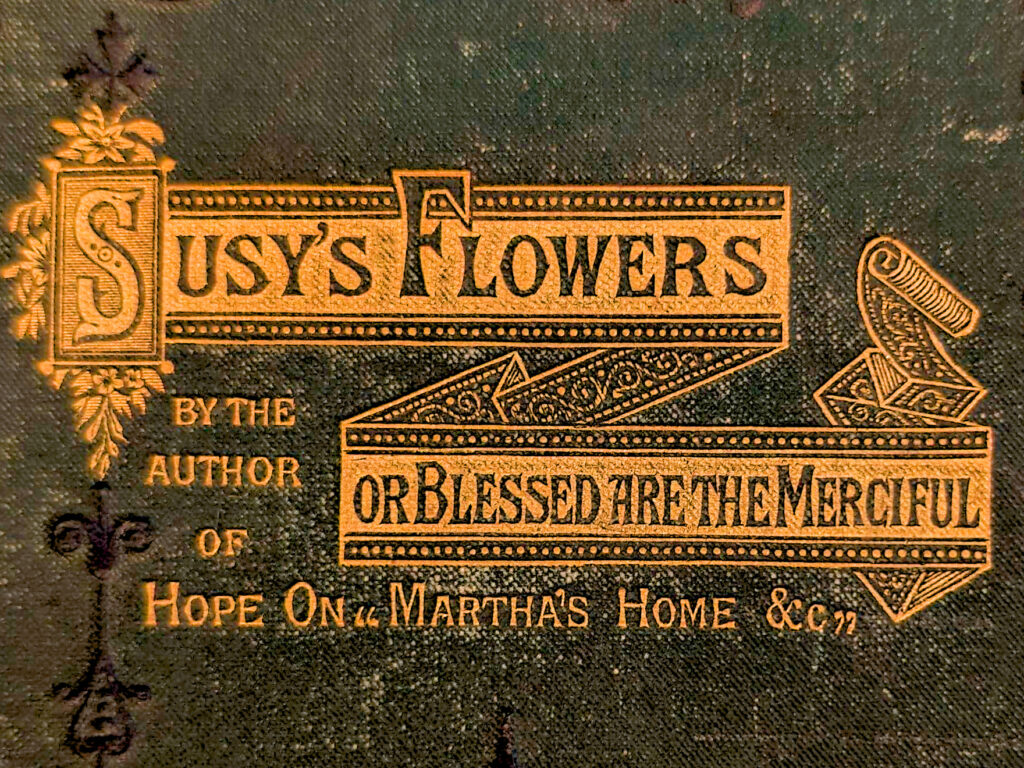
This is why stories too far from the norm don’t resonate with readers—there are no templates in the reader’s mind to aid in comprehension. Over time, the shared stories of a culture change. Take a look at books that were popular a hundred or two hundred years ago. In “Susy’s Flowers”—a book presented to my great-grandmother in 1881 as a prize for “general improvement” in school—Susy thinks she’ll be doing good if she brings strawberries from her father’s garden to a poor old widow. But her mentor disabuses her of that notion, telling Suzy she must feel the pain of losing something for it to be a true gift.
This seems harsh compared to the tone of today’s children’s books, but life itself was harsher when the story was written. Stories from the 1800’s often featured characters dying from tuberculosis, an epidemic killing people in all walks of life, making no distinction between rich and poor or intelligent and stupid. Society tried to make sense of the random depredations of a bacillus by ascribing a noble and sensitive character to the victims—they were too good to live, like the heroine in “The Lady of the Camellias.”
When our understanding of disease advanced and healthcare improved, such stories became unfashionable. The Twentieth Century saw the focus shift to stories about wars with alien invaders or evil empires. Judging by stories submitted to Abyss & Apex, the threat that most resonates in our Twenty-first Century lives is the prospect of a future where humans live in a barren world run by machines.
Just as they always have, people need to make sense of their tribulations. According to the Scientific American article, stories in which struggle leads to personal growth are preferred over stories of unmitigated woe. That feels right to me, and that’s why, in choosing what to publish, I tend toward stories whose protagonists find meaning in their lives despite changes brought by advancing technology.
Society and the stories people tell change little by little, the influence flowing in both directions. Stories need to address what people have on their minds to be relevant. They can introduce new ideas and present new solutions to problems, but if they’re too far ahead of the times, they won’t be understood by the majority of readers. The greatest stories are those least entwined in passing fads. They continue to resonate despite cultural drift. They match a deeper template, one inherent in the very nature of humanity. I always hope to find such a classic among our submissions.