 Stuart Greenhouse
Triton at Perihelion
…………i.
Soon I breathe. 672
hours by your heart’s beat— two million beats
I mean. I get confused. 672 is
the tidal period of that core you stand on.
The number is of shared significance:
soon I will pass some time upon my face
what you, your cells’ cells’ insides oscillating,
keep easily— a heat so strong that ice can melt.
What is it like to live where ice can melt?
…………ii.
I move, a drop; 672
cycles of your nervous heart I’ll thaw; 38
degrees Kelvin, then 39.3, just warm enough
to weep skyward, life-like; that is, to sublimate
my methane-and-nitrogen-clenched outer face
from rink-smooth chitin to a moist, warm air
life-bearing-like — you breathe nitrogen
gas mostly, where you live, don’t you? That means
two million beats I get to be like you:
convective, energetic, self-aware.
…………iii.
672 I’ll count until
Neptune’s elliptic tugs me back again
past inspiration; till my breath snaps opaque,
packs each sharp feature —
ridge, crater, cleft, crack, gouge, and glacier bed —
wholly under miles-deep smooth ice;
quiescent, once more banked to my own shroud,
myself both grave and stone, blank outward, lost
to deep space so long — you call it transmigration? —
a century and a half self-buried before again
allowed to return to this flowing with everything I have
in the loving and life-giving heat
of our shared and distant heart.
_______________
Note: Triton, Neptune’s moon, spends nearly all of Neptune’s 156-year eccentric orbit around the sun, frozen solid, smooth, except for impact craters gained during the current orbital cycle. At perihelion though, it’s just close enough to the sun that this shell melts to atmosphere for a short time before refreezing to a new, perfectly smooth face.
________________________________
Stuart Greenhouse lives in New Jersey with his family, writing about astronomy, memory and the distances inherent to chronic illness. Poems have appeared in journals such as Boulevard, Paris Review, and Ploughshares, and most recently in Asimov’s Science Fiction, Cumberland River Review, The Shore, Triquarterly, and Poetry Daily.
Author’s Backstory/Crafting Elements: This poem was written out of the experience of being chronically ill, bedridden and removed from life by exhaustion and pain and brain fog for 25 years (and counting, alleviated recently as it is). At one point, I took Michael Brown’s online astronomy of the solar system Coursera course and found just a deep trove of metaphorical wealth for the alienation and social difficulties my illness was affording me. In this case, Triton is envious of the energetic life Earth gets to experience, without fully understanding that the few similarities it bears chemically with Earth are superficial at best. I was going for, craft-wise, a naïve tone, something gentler than the sort of lifetime-lost anger in Bradbury’s “All Summer in a Day,” because when you’ve been sick so long and get a blessed unexplained reprieve, for an hour or so, all you are is grateful to be back to normal for each second you have. Giving a voice to the experience of illness is notoriously difficult! And I feel so lucky to have found, in astronomy, a vocabulary to try.
Editor’s Comments/Image Credit: I will add that all the fields of science provide fresh sources of metaphors. For example, as an unapologetic promotion, my full-length poetry collection, Flux Lines: The Intersection of Science, Love, and Poetry (Linnets Wings Press, 2022), mines different scientific disciplines to have a conversation about another abstraction: romantic love. The work does not require a scientific background beyond a high school understanding of basic concepts, if even that, but those who are well-informed will appreciate the scientific accuracy.
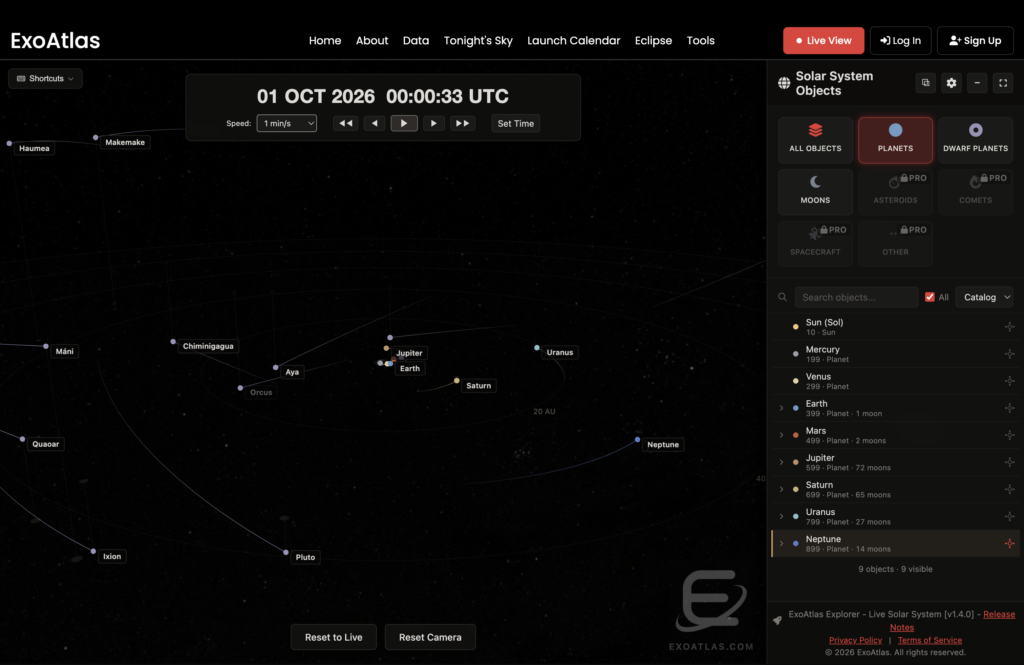
NASA public-domain images of Triton are entirely free to download and share, though they document a single historic flyby rather than a specific “perihelion” phase, as Triton’s orbit around Neptune is almost perfectly circular (eccentricity of 0.000) [ExoAtlas].
The only close-up photographs of this icy moon were captured by the Voyager 2 spacecraft during its encounter on August 25, 1989. You can view and download the official, high-resolution imagery directly from NASA and related public archives. A 20-minute video is informative [https://www.youtube.com/watch?v=tu8P1C29Olw].